
The number one way to sound better as a beginner ukulele player is to tune your ukulele.
Your audience will thank you for it and you’ll be inspired and even surprised by the beautiful sound you create!
A lot of new ukulele players don’t realize the ukulele has to be tuned frequently to maintain the best sound. Relatively cheap ukuleles require more frequent tuning whereas higher-end ukuleles often hold their tuning for longer.
As a rule of thumb, check your ukulele tuning every 15 minutes.
Now this might sound like a lot of tuning at first but with this lesson you’ll be a pro at tuning your ukulele quickly in no time at all.
In this lesson, learn how to tune your ukulele quickly and easily, as well as:
- How to tune your ukulele quickly with a chromatic tuner
- Discover what “standard ukulele tuning” is
- How to tune your ukulele by ear
- How to tune if you’re a “left-handed” ukulele player
- Explore alternate ukulele tunings like “low G” and baritone tuning
- What strings to use (and how to know when to change your ukulele strings)
Let’s take a look.
How to Tune Your Ukulele the Fastest Way
In this video lesson, learn how to tune your ukulele.
This tuning method works for almost any ukulele including soprano, concert and tenor ukuleles.
The fastest and easiest way to tune is to use a chromatic tuner, which I show you how to use in the video above.
A chromatic tuner is a device that detects the pitch of a note as you pluck a string of the ukulele. With the aid of a chromatic tuner, you can quickly identify if you are sharp or flat (that is to say “too high” or “too low” in pitch) relative to the desired note. I prefer the Snark SN-6 ukulele tuner that clips on to the headstock of your ukulele, although there are a wide variety of “chromatic tuner” apps you can download for your smartphone.
By the way, did you enjoy that video lesson? You can learn to play your first songs with me on ukulele in the FREE 45-page ukulele lesson book Your First Ukulele Lesson and Then Some delivered right to your email inbox.
To get a free copy of the digital lesson book delivered to your inbox, just enter your email below:
Yes! I want the free ukulele lesson book Your First Ukulele Lesson and Then Some.
Please note: I take your privacy very seriously. I promise never to spam you or distribute your email to a third party.
“Thank you so much for these wonderful lessons. I have been inseparable from my (new to me) ukulele and am beyond thrilled that these lessons are allowing me to learn how to properly play it. I can tell that this relationship with my ukulele is going to be a lifelong bond. I can’t wait until I am experienced enough to play and sing songs to my 3 children. They have, thankfully, been enjoying the (nearly nonstop) strumming and lovely sounds being produced by my beloved new little friend. And that is thanks to you.”
– Lydia C., Student
Tune to These Notes in Standard “Reentrant” Ukulele Tuning
Most soprano, concert, and tenor ukuleles (read more about ukulele sizes here) will be tuned to standard reentrant ukulele tuning. The following figure shows a right-handed ukulele tuned to standard reentrant tuning.
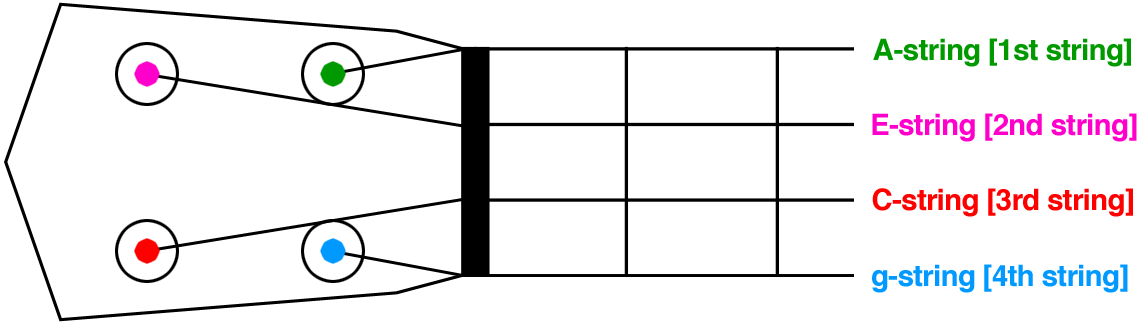
As you can see, the bottom string or first string is tuned to an A. The second string is tuned to an E. The third string is tuned to a C, and the fourth string or top string of the ukulele is tuned to a G.
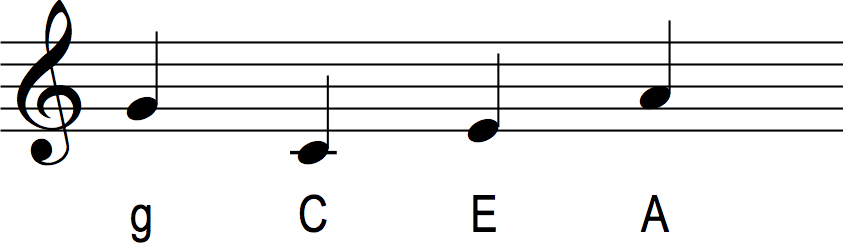
Please note the above figure is a “top down” perspective of the ukulele, as if you were supporting it in your lap, ready to play. In this way, the bottom line of the figure represents the top string of the ukulele; likewise, the top line represents the bottom string of the ukulele. From the top to bottom string, see how a ukulele is tuned on the music staff.
And see how a ukulele is tuned on the piano keys.
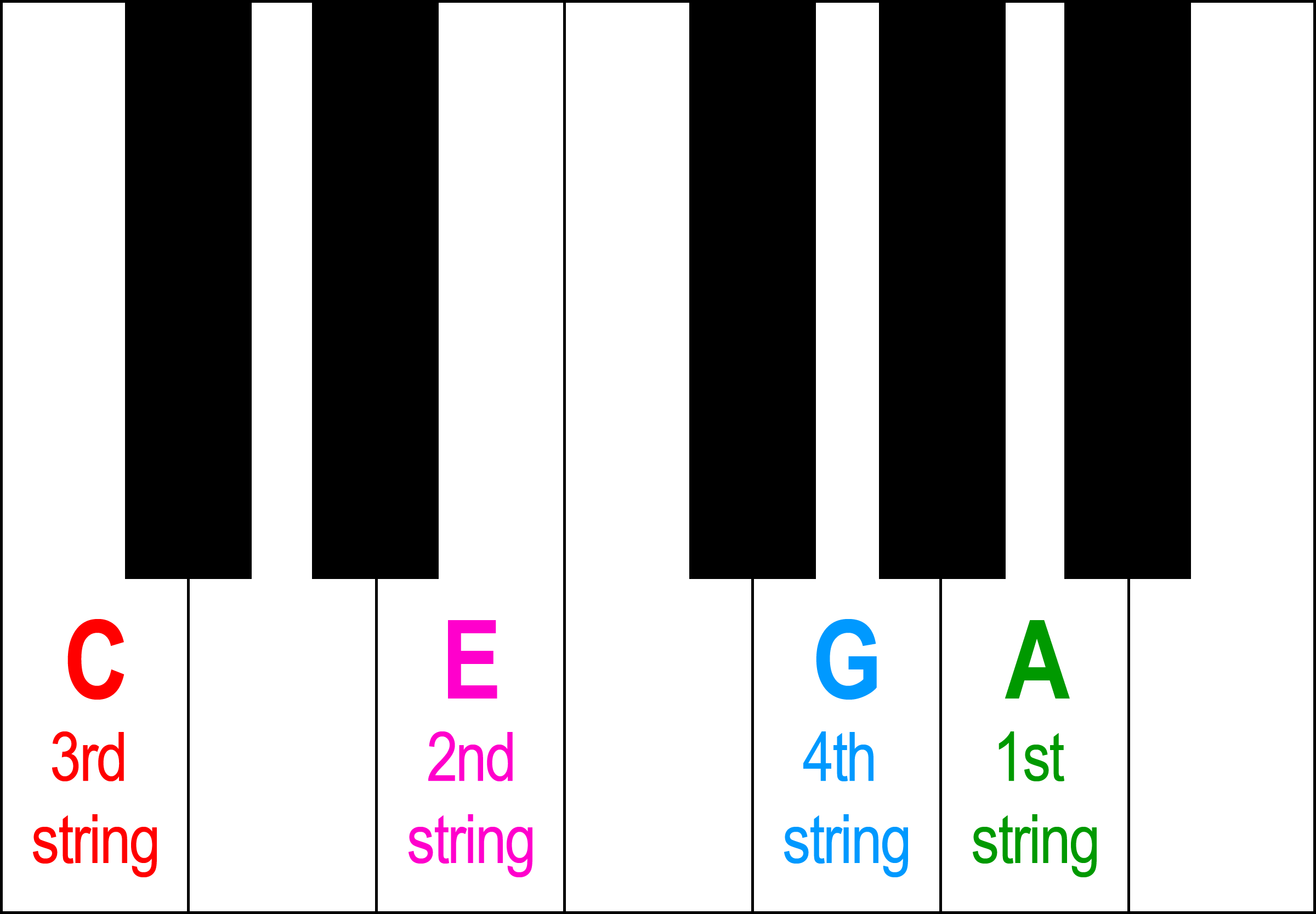
Notice that the top g-string (4th string) is tuned higher than the middle two strings – the top gstring is tuned to a G-note above middle C on a piano. This is why it is called reentrant tuning. The lowercase “g” is used to indicate that the G-note is above middle C.
Reentant Tuning vs. Linear Tuning (High G vs. Low G)
If you’re used to playing guitar, it might seem odd that there is a high g-string. In standard reentrant tuning, the pitch of the strings on the ukulele don’t go from lowest to highest. This tuning is part of what makes the ukulele have that bright and charming sound. Reentrant tuning gives you the most even tone because the strings are kept in a smaller range.
However, some ukulele players prefer to tune the g-string down an octave to play in low G ukulele tuning (learn how to tune to low G tuning), sometimes referred to as linear tuning because the strings are arranged from lowest to highest. Not only do you get a broader range with low G tuning but some might consider the sound to be a more full and resonant.
Warning: Please note if you want to tune your ukulele to low G you will need a special set of low G ukulele strings based on your size of ukulele. Do not try to tune a high-g ukulele string down an octave because it will not sound pleasing!
How to Tune Your Ukulele By Ear
What if you don’t have a chromatic tuner or a piano nearby to tune your ukulele?
If this is the case, order a chromatic tuner as soon as possible or download a chromatic tuner app on your smartphone. The sooner you do this the easier it is to tune!
Still though, learning how to tune your ukulele by ear is a handy skill and is a great exercise in training your ear to detect differences in pitch.
First, listen to each of the ukulele pitches.
g-string (4th string)
C-string (3rd string)
E-string (2nd string)
A-string (1st string)
To tune your ukulele by ear, listen to the pitches as a point of reference for tuning your ukulele.
Then, play the top g-string audio. As the sound is playing, hum the note and get it in your head. Do this before plucking any strings on your ukulele. Once you’re certain you’ve heard the pitch, pluck the top string, or the g-string, on your ukulele. Now, get this pitch in your head.
If the pitch of the plucked string is higher than the pitch of the sound playing on the tuner, that means the string on your ukulele is sharp.
If the pitch of the plucked string is lower than the pitch of the sound playing on the tuner, that means the strings on your ukulele is flat.
As both sounds are ringing, turn your tuning pegs on your ukulele to match the two pitches. When the pitches aren’t matching, at the initial attack of the two sounds, you’ll hear almost a warbly sound between the two like this:
When the pitches are matching, the warbly sound will be gone and the two sounds will ring smoother against each other like this:
These are the essentials to tuning by ear.
Remember, the most accurate and easiest way to tune your ukulele is to use a chromatic tuner.
How to Tune Your Ukulele if You’re “Left-Handed”
I’m a dominant left-hander, meaning, I write with my left hand and using my left hand comes most naturally to me, so let me be the first to say I understand where you’re coming from!
That said, if you’re a leftie who is just learning to play ukulele then I recommend you tune your strings as shown above using your left hand to fret chords and right hand to strum. This will allow you to follow along with me.
Equal use of your dominant and non-dominant hand is required to play ukulele, which is why I don’t recommend playing “left-handed”. Learning to play ukulele is going to feel awkward at first, so embrace it and press through it. You can do this!
The only exception I’d make to this is if you’re missing a finger or have a physical impairment that restricts the movement of one of your hands (such as arthritis). If that is the case, then, you will need to re-string your strings in the opposite order and tune accordingly. Do not flip the ukulele around or play it upside down. It will be easier to play “left-handed” if you re-string the ukulele in the inverse.
You’ll thank me later for pushing through the awkwardness and learning to play ukulele where you use your left hand to fret the chords and right hand to strum.
How to Tune Your Ukulele to Alternate Tunings
Here are some other ukulele tunings used by different ukulele players.
Baritone Ukulele Tuning (D, G, B, E)
Baritone tuning is used on baritone ukuleles and sometimes even on tenor ukuleles. This ukulele tuning is equivalent to the tuning of the last four strings on a guitar. Sometimes this tuning is referred to “G tuning.”
If you have a baritone ukulele and wish to follow along with my lessons, follow this guide here.
Slack-key Tuning (G, C, E, G)
Popular in Hawaiian music, in slack-key tuning, if you just strum the strings as open strings, you’re strumming a C major chord, which makes this a very open tuning. The top g-string can be tuned either in reentrant or linear tuning, meaning you can either tune it to the “G” note above middle C on a piano or down the octave.
English Tuning (A, D, F#, B)
English tuning, also considered as a “D tuning”, this tuning has the same amount of intervals (the amount of notes between each string) as standard ukulele tuning but every string is tuned up a whole step higher. You’ll want to use an English tuning string set if you wish to tune in this manner. This tuning is popular for soprano ukuleles or banjoleles. Some find this tuning to be a bit sweeter in tone.
Canadian Tuning (low A, D, F#, B)
Canadian tuning is nearly identical to English tuning except you tune the top a-string down an octave. This tuning is popular for concert and tenor ukuleles.
What Strings to Use (and How to Know When to Change Your Ukulele Strings)
As a general rule of thumb, plan to change your ukulele strings every three months or so with regular daily playing.
Old ukulele strings begin to sound duller and not as lively. Strings wear out with playing which is why for the best sound it’s a good idea to change your strings every few months.
A lot of ukulele players wonder what the best ukulele strings are.
You can’t go wrong with Aquila ukulele strings (soprano, concert, tenor), but there are other brands worth trying like Worth, D’Addario, and more.
Every ukulele responds differently to different strings, so I recommend to experiment and have fun with it! See which strings sound best on your ukulele.

When you tune the G string down the octave, do you change out the string?
Steven, I replied to you on the “White Christmas” post as well, but I just use a wound low G string. I don’t switch between tunings on this tenor uke. I like the low G sound on it too much, although sometimes I wish I had a concert or soprano uke for that reentrant sound.
Hi..I have a Lanikai Concert with Aquila strings, standart tuning and you said “However, some people tune the G down an octave (linear/low 4th tuning)” How would I do this? I set my pitch at 444 instead of 440 on all strings so I get 528 on the A string. Do I have to get a different G string? Thanks..
Keith, most people find that a different G string works a lot better. I have a wound G string verses a nylon string. This helps keep tension on the string. Chances are if you tune it down an octave with a regular nylon G string the string will be really loose and won’t hold a tune very well. I think Aquila makes a “Low G” string set for this if you wanted to stick to that brand. The best thing to do is tune your G all the way down an octave and give it a try. Hope this helps!
Keith, if you use a 444 A instead of a 440 A you won’t be able to play with other people. 440 A is the standard. All the ukes and guitars and pianos are using it.
Newbie question. Can you use GCEA strings to get English tuning or do you need a special set? I’ve run across some strums (by Coveywood on youtube) that sound really nice with English tuning.
Also, do they ever stop stretching? I’ve had my uke for 5 days now, stretched them every day, and they’re still flat every time I pick it up! I just keep cranking them back into tune. I’d think they’d reach a limit and either stay (nearly) in tune or break.
Hey Mike, I wouldn’t have any problem using a standard set with English tuning. I think I have seen some string sets out there that are created for a whole step up, but they seem to be hard to track down.
Strings will always stretch and change a little bit depending on the temperature and humidity. It usually takes a few days to a week till I feel like my new strings have “settled.” Another factor that can effect tuning is the quality of the tuners/tuning pegs on the ukulele.
For me, I always like to tune my ukulele before I pick it up and play it, even though my ukulele holds pretty good tune. I like to know that I’ll be sounding the best I can.
Thanks Brett, that’s kind of what I thought about English tuning. I always tune my Makala before playing also. I’ve been tuning it with my guitar tuner, which works with all of the stings except the C. I’ve been fretting the C up to an E and then tuning it. Seems to work pretty well. The stock strings seem to have an infinite amount of stretch, but they seem to stay in relative tune fairly well. Thanks again for you reply!
Mike.
Hi there,
I’ve been watching and listening to your “11 must know chords” and while playing them with my own (tenor) uke I realised it sounded completely different than yours, tried to tune it as shown on a video I found and burst a string! …..:( haha! As you might have guessed I am totally new to this! Right, the thing that puzzles me is that on your site you say that there’s a different way of tuning in England, where I am based. If so can I learn your “11 must know chords”as it doesn’t sound the same??
Hey Danielle, ahhh yes, sometimes tuning can make you break a string. Especially drastic tuning like a low G tuning. The best thing to do is to get a special low G tuning string set. The chord positions will be the same for English tuning, but the pitch will sound a whole step up, because you are tuned up a whole step. Does that make sense?
thank you
Good stuff, as ever! There are three things I’d think are worth adding here, though. One, it’s pretty easy to find free tuner software for computers, serving exactly the same function as an electronic tuner off the shelf – I’m currently using PitchPerfect for the Mac, for example. It’s still probably worth investing in a dedicated little machine, though, for portability.
Two, for anyone who’s played guitar a bit, it’s worth noting that standard uke tuning has the same intervals as the top four strings of a guitar, just tuned up a fourth (i.e. five semitones) and with the G an octave higher! Hence the fact that so many ukulele chords are the same shape as guitar chords without the lowest two strings…
Three – it’s surely worth knowing how to make sure a ukulele is in tune with itself, for those times when you don’t have anything else to tune it to?
You talk about being able to have a ukelele in tune with itself – I have a makala (soprano?) ukelele, and am quite able to tune it to an electronic tuner (like I use for my violin), to gCEA, but it is not in tune with itself! Is this a generic fault with the makala, or have I got a bad one? My daughter is playing it, I have close to perfect pitch, and the out of tune chords are driving me crazy.
I imagine that this is an intonation issue with the Makala ukulele. Some cheaper ukuleles have these sorts of issues. If you have a decent year, this will drive you crazy. Whenever I have an intonation issue, sometimes I hold down the strings at the 3rd fret and tune those, since usually you notice these intonation issues when you are playing chords and holding down notes. Best of luck!
Holding down the strings at the third fret to tune for a standard GCEA tuning would mean you’d tune to A#D#GC. That’s a great tip. I have a cheap Kohala ukulele that’s sharp a half-step on the C string by the seventh fret. It’s less annoying to play with this type of tuning. It doesn’t make me cringe as much to listen to it.
What does it mean ‘in tune with itself’.
Hi- Im new to this I get confused with the tuning I have a very old book (first pub:1926) that says tune to ADF#B & most sites stage gCEA I have a soprano Monterey (not sure if this is a good one or not as no experience) I have tuned it to gCEA I can tune it to my piano but have great difficulty getting the C to tune in to middle C (Is that what its supposed to tune to?)the strings I have are the ones It was purchased with
ps having fun with my learn to play e-book am practicing twinkle twinkle & driving hubby mad
Hey Alisa, you might try putting new strings to see if that helps with the tuning. Sometimes the strings that come from the factory aren’t very good. I’m glad to hear you’re enjoying the ebook!
Hi, I have a question regarding tuning but can not find an answer, so I give it a try here…
My ukulele is tuned in (the English) A,D,F#,G,B
But why do no one tune up the F# into a G, then you will have the same tuning as a guitar except the E-strings. I found this easier since I have played guitar before.
Is there anything that is wrong with this? (wondering since I can’t find that tuning)…
Regards,
Magnus
Hey Magnus, let me make sure I understand this correctly.
Are you suggesting a tuning of A, D, G, and B?
I don’t see why you couldn’t give this a try. The only problem you might run into is snapping your “F#” string since there would be more tension on it. I say tune it that way and see what you think!
Hi, thanks for your quick replay.
Yes, my idea is to tune up the F# half step to G than I can play the chord pattern in the same way as on the guitar (except the high and low E). My concern was more if I will miss some “ringing” harmonics when play the chords like a guitar.
I will give it a try. Thank you!
/Magnus
How about for a bariton Uke
Hi Jo, a baritone ukulele is tuned like the bottom four strings of the guitar (DGBE). You can use my free online ukulele tuner to tune your baritone ukulele.
hey Brett, is it okay if we use GCEA tuning for a baritone ?
Hi Annie, I’ve heard from many baritone ukulele players who do this and have success. If you can, I recommend purchasing a set of strings in standard tuning designed for baritone ukuleles.
I’ve got a set of Ukulele pitch pipes. Do ever tune your Ukulele using these?
Warren, thanks for the comment! I have never used pitch pipes to tune my ukulele. I prefer the ease and accuracy of a chromatic tuner. 🙂
This is a fantastic site, thanks for what you’ve given to the uke community!
I have a question about tuning for a concert uke that I just purchased (Kala KA-C) – would you recommend low-G tuning, or gCEA standard? I don’t mind changing the string once but I’d like to settle on one or the other (I play a bit of guitar so low G seems more natural to me).
Say I do change to low G, then some of the chords will actually be inverted, eg. C would really be C/G would it not? Does that make much difference? Clearly the uke would have a lower range, but some of the chords would also sound slightly different in their bass note as well. I’m certainly not interested in changing or learning yet more new chord patterns, just wondered what your view was.
Thanks!
Darren, that’s a good question. If I had a concert, I would probably keep it in standard tuning, but this is because I have a tenor ukulele right now. I did end up switching my tenor back to standard because I found that some chord shapes sounded weird because they were inverted chords. At the same time, I will say that even a low G tuning uke, doesn’t have a booming low register, so these inversions aren’t THAT awkward.
Here’s what I would do… by a low G string set and a standard string set and try the low G string set first. After a couple weeks, give the standard string set a try and see which one you like better. 🙂
Thanks, Brett – sounds good to me!
As a guitar player, who just received a ukulele for his birthday, I am wondering what the main disadvantages to tuning the strings like a guitar would be. Does the ukulele sound worse with this tuning? Does it increase strain on the strings or on the neck of the ukulele?
If you were to tune your ukulele to the bottom four strings of the guitar, you’d have a hard time getting enough tension on the strings since DGBE is lower than GCEA (standard ukulele tuning). You might try a pair of baritone ukulele strings though, since a baritone ukulele is tuned like the bottom four strings of a guitar.
I’d recommend trying out standard tuning first. That tuning will give you the best sound out of your ukulele. 🙂
I bought a set of Low G strings and then had to “mix & match” sort of to get a good sound and proper tension. Just because a string might be the A or E string that dosen’t mean it can’t be tuned to another pitch and used in a different slot.
I have a Makai tenor and am much happier with it in the DGBD tuning.
Quick question – i bought a soprano and want to play with someone who has a baritone. can we tune them both to GCEA and work on the same songs?
Hey Matt, it’s not the best idea to try to tune the baritone ukulele to GCEA because you’ll probably break a string. The easiest thing to do is buy a capo and have the baritone player capo to the 5th fret. This will put him in the same tuning and pitch as you so he can use the same chord positions as you.
how do you tune to the key of F?
Standard tuning is GCEA, so if you tuned down a whole step, you’d be tuned to F Bb D G, which may give you what you’re looking for.
Wouldn’t that produce a Bb tuning, not F tuning?
The key of F and Bb are very similar aside from one note, so you could see it that way too.
I am a beginner uke player–just bought a Cordoba CM15 concert uke & a chromatic tuner. I am having a terrible time with the E string keeping its tune. Any suggestions???
Depending on how new or old the strings are, they could need some time to break in and “settle.” You might also try putting new strings on it if you are playing the stock strings that came with it. Sometimes strings that come with a new ukulele aren’t so good. If you continue to have problems with it, it might be your ukulele’s tuner, which you could take to the store and get that looked at.
Hey Brett!
I’ve had my cheap concert ukulele for a while now and decided to replace the pretty awful ones that came with it. However, the strings (like the old set, I think) seem to be tuned an octave lower than they should be, and I really can’t understand why. I’ve tried tuning them up but the only one that will go high enough is the C string, and the others will reach a point where they simply won’t go any higher. Am I doing something wrong? Or is it a problem with the ukulele/strings? Thanks a lot! 🙂
Hey Ben, that sounds really odd. What kind of strings did you buy? Are they designated on the packaging as a gCEA or standard tuning string set?
I have a tenor ukelele and I want to tune it like a baritone.Do I understand correctly, from the previous discussions that all I need to do is buy a set of baritone strings and put them on my tenor? Will there be any problems with doing that, such a strain on the instrument? Thanks a lot!
Hey George, you shouldn’t have a problem with this. There shouldn’t be unnecessary strain since you are tuning the baritone ukulele strings lower.
So if I have a harmonica in the key of C and I am considering getting a uke to play with it, am I right in thinking that a baritone uke would be the best to keep the tuning together?
Hey Dave, you can use any ukulele you want with a harmonica in the key of C major. The trick is to just play songs that are in the key of C, or chords that are found in the key of C: C, Dm, Em, F, G, Am, Bdim.
Is there a way to make a concert ukulele sound like a soprano ukulele?
It’s difficult because a soprano ukulele is smaller by nature which gives it a bit of a different tone. Tuning to standard tuning is definitely helpful (gCEA). You can experiment with different strings to see if you can find a set that has a real bright sound.
how do you play a ukulele
Hey Joliena, I recommend downloading my free ukulele lesson book on the right side bar! It will get you started.
Is it possible to tune a baritone ukulele to the gcea? Are there special strings to do this and prevent string breakage?
I’ve never done this, so I’m not sure how well it would work, but you’ll most likely need a set of standard ukulele strings. My recommendation would be to leave your baritone ukulele tuned how it use but purchase a capo that you can put on the 5th fret of your uke. By doing this, you transpose the tuning up to standard ukulele tuning.
Actually, Aquila makes a set of Baritone strings in AECG. I was really missing the higher octave G on my new Bari Banjolele, so I switched to the Aquila set. They’re holding tune fairly well (I just put them on a few days ago, and they haven’t settled completely yet). The only problem I’m seeing is that the strings are a little looser than I’d like. But, they are available!
Great to know! Thanks, Michael.
Hi Brett, I just bought a tenor ukulele and it was tuned in Baritone tuning upon purchase. I tuned the strings up to Standard tuning and I think it sounds fine, but there seems to be a lot of tension now in the strings. Do I need to purchase different strings now that Ive change the tuning? Im more concerned about breaking my new ukelele if Im using strings designed for baritone tuning but tuning them in standard tuning. Thanks
Hey Dan, I woud get some standard ukulele strings ASAP. I wouldn’t be surprised if those old strings are putting a lot of tension on the neck of the ukulele. In the long term, this won’t be good for your ukulele.
I dont know what is a tuner…-.-
Hi Jovan, a tuner allows you to tune your ukulele strings to the correct pitch. This is so you can play the instrument in tune.
I dont know how to tune a Ukelele and I dont know how to play it too 🙁
I recommend clicking around Ukulele Tricks. There is a lot of helpful information here! You’ll definitely want to get my free lesson book to on the right hand side if you haven’t already.
Jovan….tuning is simple. You buy a tuner….i have one that is chromatic and clamps on the top of the ukelele. When you hit a string it shows you the name of the string and how low or high it is. You just turn the pegs at the top left or right to make the string sound go up or down until it is in the center of the tone you are looking for.
Secondly….look on this site and find a simple song..like twinkle twinkle little star….
strum down and count to four….4/4 is four beats per section. 2/4 is 2 beats per section separated by a line….tune first….practice a song….What i like to do is learn all the major chords A thru G. Then, I learn the minor chords Am thru Gm….then you can learn 7ths and other chords as they appear in a son. Don’t give up cause it’s hard at first….and sing. I am practicing IZ’s Somewhere over the Rainbow/What a wonderful world. Find a song you know how to sing….and, don’ t try to be a professional….i have played guitar for 40 years, but, have never been in a band…why?? because i always looked at it as a HOBBY, NOT A CAREER. Thus, i have not put any pressure on myself to do anything but enjoy it at my leisure….Good luck!!!!
Hello Brett,
What a great site!
I’m teaching ukulele in Canada and I’m using D tuning instead of C. I’m also using low a instead of high a, but there isn’t an option on the tuner you have available (you just have high a). If you did have that option, I’d send my students the link so they could tune their instrument at home. It’s just a friendly suggestion that would help us out a lot as I haven’t been able to find that specific tuning!
Thanks for considering 🙂
Hey Sarah, suggestion noted! Thanks so much for your feedback. 🙂
Hi Brett! I just bought an Oscar Schmidt OU7T, Tenor, Spalted Mango ukulele last week and I don’t know if I should laugh or cry. The ukulele itself looks stunning, but the strings are.. Well, terrible or what? When I tune it to GCEA the strings are really loose and it sounds so deep. And also, when I play the E and the A string on the two first frets it buzzes, why? It sounds terrible.
-Nick.
Hi Nick, the first thing I would check is to make sure you aren’t tuning the strings down an octave. If it sounds too low for a ukulele, then it’s quite possible you need to tune an octave higher. The strings should feel tight with tension. The next thing to do is change out the stock strings to something else (I’ve been using Aquila strings lately). Lastly, if those things don’t help, I would take it to your local music shop and see if they can take a look at it and potentially do a basic “set up” on the ukulele.
Hi …If I tune to GCEA will I have to learn new chord positions from gCEA tuning?
The chord positions can be used between the two tunings.
Hi Brett!
Thanks for all the great information and instruction! Can you explain why it is that ukes use the high g tuning? I’m new to the uke and it seems kind of strange.
Thanks!
Hey Jason, the ukulele is tuned in high G to give it that bright “chimey” sound. It is a little strange, but it sounds really cool!
umm so when i hold it the first string is the bottom right?? i saw another website that said it was the top string but im having doubts, haha its my first time touching a ukulele. 🙂
The bottom string of the ukulele (A-string) is commonly referred to as the first string, although I have seen it referred to it in different ways too. 🙂
can you tune a Baritone Ukulele like a normal ukulele?
Definitely! You can use the same chord shapes since the strings are tuned to the same intervals, but a normal ukulele “C” chord won’t sound as a “C” chord on a baritone ukulele because it is tuned differently.
I tried to tune my new tenor uke to guitar tuning since I have played guitar all my life, easier than learning new chords. I snapped the highest string. Does it work to buy strings for a baritone uke and put them on my tenor?
Hi Lynn, I would expect it to. Were you tuning to DGBE or GCEA? If you wanted the guitar vibe with the ukulele, I recommend low G tuning (linear tuning). These would be the same chord shapes as a guitar capo’d at the 5th fret.
Hey Brett! Love your page. I have a samll soprano uke but i’m a real beginner. I don’t know how to tune it by ear. I am trying to use an android aplication called G strings, but I think it’s not that good. I’ve tune it o GCEA, but none of the chords sound good. Please help me 🙂
Oh yes, I forgot. Is the g chord the same as the G chord? or A or a? i’m really not good at this and this is my first meeting with an instrument haha 🙂
Brett, I’ve bought a 4 string uke in Tahiti and the A string is set lower than the middle two strings, only been playing a couple days and there is no problems with strumming chords but any picking stuff is sounding weird. So I have a high G, lower C and E and then a higher A. Is this a recognised string pattern or do I need to change my strings? Dan
Hi Dan, that sounds right to me. Ensure you are tuning up every time before you play. Does the tuning sound weird for certain chords?
Hi, I would like to learn how to play a small part of I Knew You Were Trouble (chords here http://ukutabs.com/t/taylor-swift/i-knew-you-were-trouble). However, it is said on the page that if I tune the ukulele 4 half steps down, it’d be easier. How do you tune the ukulele 4 half steps down? What does it mean?
Hi Dorine, that tab is saying to transpose that chord chart down 4 half steps to make the chords easier to play. Click the ‘-4’ at the top of the page to get the new chords.
Hi!
Ive bought my sisters two soprano ukes for christmas but were having trouble tuning them, i have a guitar and a tu80 metronome but was unsure if i can tune them with that? Tuning the first string is proving a little difficult aswell!-should i tune then let the string stretch before tuning again?
Thanks 🙂 great website!
I like to sing along as I play my suprano uke. But I can’t seem to play in the key that is comfortable for my voice; not that I can hold a tune in a bucket! I have tuned down my uke to FBflatDG and even E….. Still sounds good using the same fingering.
What’s the right way to play a uke in a different key and does a concert, tenor, or baritone uke make playing in a different key easier. (I know guitars use capos.)
Hey Alli, you don’t have to retune your uke at all, simply play the song in a different key, i.e. if the chords of the song are shown as C F &G7
then change the chords to say A D & E7 which are a tone and a half lower and may suit your voice better.
Im brand new to ukulele and Ive never played a musical instrument before except piano for a very short time as a little kid. I bought a ukulele starter kit and it came with a Cherub WST-55OU tuner, but I don’t know how each string is supposed to look on the tuner. It’s got 4 lights that say 4GA, 3CD, 2EF, and 1AB. And then there is row of lights with number +50 through -50. But all that ever lights up is the 3CD light and the row of numbered lights on the side (if that makes sense?)no matter how drastically I tune a string it doesn’t change to the G, E, or A light. and I know I’m not that of tune. Am I reading it wrong or did I get a piece of junk tuner?
Thanks!
-Danielle
Hi Danielle, you may have gotten a crappy tuner. It’s possible that your strings aren’t even close in the ballpark to the 4GA, 3CD, 2EF, and 1AB, so it isn’t even registering.
One thing you can try is “spot tuning” by ear with my online ukulele tuner: http://www.ukuleletricks.com/ukulele-tuner/
And then, try tuning the strings to see if the tuner picks them up.
If that doesn’t work, I might consider returning the tuner and trying a different one. I really like the Snark ukulele tuner.
Hi, i have a Mahalo U30 and i just bought some Aquila Nylguts and strung them and now even when the tuner says they’re in tune, when strummed they sound absolutely terrible. Any suggestions or help is appreciated!
Hi Stephan, it’s possible your strings need to “break in”. Are they going out of tune after you play for a little while? It’s also possible that your ukulele has an intonation issue, where you fret a chord and press down on the strings and the chord sounds out of tune.
Hi Brett,
This might sound a little crazy but Im wondering is it possible to tune the C string of a soprano uke up an octave?
Hi Dom, I wouldn’t recommend doing this with a standard C-string. If you are going to try this, I’d recommend using another high A-string. I’ve never heard of this being done, so I’m not sure how it would work or what kind of strain it’d put on your ukulele neck. In this way, I can’t recommend doing this.
Hi! It seems that when I attempted to tune my Ukulele, the string snapped. I’ve read most of the comments and they’ve helped me, but what type of string do I have to buy for a soprano Ukulele (high g tuning of 4th string). The broken string was Nyguts, and I might need some help fixing them.
Hi James, every now and then this happens. I like to use Aquila gCEA ukulele strings. I know others have had good success with them as well.
I requested and received a ukulele for Christmas, and have been actively practising since mid January. I am 47 years old and have no absolutely no previous experience of playing a musical instrument. I am thoroughly enjoying trying to teach myself and researching sites like yours. My most annoying problem (apart from extremely poor chord changes), is the “string buzz” noises I continually hear. I know this can be caused by poor quality strings and/or finger positions on the fret board however I was also wondering if this could be worsened if the strings are too loose? I am aware that I shouldn’t tighten strings too much as they will break however, my “E” and “A” strings feel very slack. I purchased a chromatic tuner so the note being delivered is the correct one (I think!). I tried to tighten these strings to the next level (is this known as “up an octave”?)l but the strings were getting very tight and I backed out in case they broke.
Any advice you can give would be greatly appreciated.
Also, given that I have only been learning for 2 months, I am fairly happy with my progress to date, but being very impatient, I am very keen to be progress further. How long would you say it takes an average pupil to become fairly proficient? I am also seriously considering an on line course such as yours. I take it this is something you would recommend?
Many thanks in advance for your time. Keep up the good work!
Regards,
Hi Gary,
Congrats on the new ukulele! That’s exciting. It sounds like you might need to tune your ukulele strings up the octave. They shouldn’t be very loose. If you have this available in your town, I’d recommend stopping into your local music store and getting it checked by someone to see if you are in the right octave. If you buy a new pair of strings, they shouldn’t have a problem taking a look at this for you.
I think that a course like mine could benefit you quite a bit. I created the course to be step-by-step and easy-to-follow. I give you some specific practice objectives and songs to learn to apply your skills too. This can help give you some focus as you learn how to play. If you have a ukulele group in your city, I’d recommend checking that out too. I always learn a lot about my own abilities when I’m making music with others.
Hello Brett, Thank you for keeping up this site. Question: does Jake Shimabukuro use a high or low G string on his Kamaka? I have just listened to him play on YouTube and the virtuosity is astounding!
James Hill (a virtuoso also to be sure) recently wrote me that he used to play low G mostly but now is doing more high G tuning playing. What’s easier? I need all the help I can get playing (learning) this thing! My uke (well, it’s my wife’s–a very nice Mainland concert), has the high G and it seems counterintuitive (or some other “choice” adjective) at times! Many thanks.
Hi Frankevich, I’ve known Jake to use a low G tuning for a lot of songs. I’m sure he uses a standard tuning as well for many songs. This is why you need more than one ukulele 😉 A lot of this comes down to personal preference. I recommend experimenting with both to see what you like. I agree that standard tuning can feel a little counterintuitive, especially if you come from a guitar background. For what it’s worth, there isn’t a write or wrong tuning to learn with.
Hi Brett,
Just found your site it’s fabulous!! I have a tenor uke tuned to gCEA. If I wanted to try the low G tuning with a set of low G strings, could I switch between GCEA and gCEA with that same set of strings?
My Lanikai S-T tenor has the original strings from when I purchased it, they are black nylon g, E, and A strings and a metal wound C string.
Thanks.
Hi Rick, with a low G set of strings, you want to tune to GCEA. There would be too much tension on the top string that could potentially break the string or cause harm to your ukulele.
Hello,
I am NEW to ukulele and am so happy to have come across your site! I have a little mahalo uke and when I have it tuned the 2 and 3 strings are “looser” than the top and bottom – which are quite tight. Does this make sense? Is this tuned correctly?? Thanks! 🙂
Hi Kristen, the middle two strings should have slightly less tension since they are tuned lower, but they should still ring out in a clear tone and pitch. Are they ringing out clear for you?
I just got my new Mahalo Tenor… trying to tune it up I noticed that the top string is smaller in dia. than the #2 string… is this correct? I am a bass player and it just doesn’t seem right????
I should have read all of the string first………… With a tenor, can i tune it like a baritone
???
Hi Bob, I would be concerned about doing this because of the tension the higher gauge baritone strings would put on the neck of the tenor ukulele. To minimize the risk of doing damage to your ukulele, I would recommend getting your tenor ukulele “set up” by a professional luthier for baritone ukulele strings.
Hi Bob, yep, this is right. The ukulele is tuned in a reentrant tuning, where the top string is tuned higher than the bottom three strings. This is unlike a guitar or bass where the tuning is linear across the strings.
Hello, I haven’t gotten a ukulele yet but I am planning on getting a Dolphin Soprano uke. In another post, you said it would probably want to get better strings than the ones that it comes with. What kind of strings do you reccomend? Sorry I’m new to this whole uke thing :I
Hello. My sister and I bought a Lumanog Ukulele. The seller says its a baritone ukulele with 19 frets. We made him (seller) tuned the ukulele. But as I try to play the ukulele, it sounds strange and much lower than the typical baritone ukuleles I hear on youtube. I’m frustrated. All the chords that I tried to play doesn’t sound right. I noticed that most baritone ukuleles have two thick strings on the upper part while my two thick strings are on the middle of the thin strings. Help me please? 🙁 I feel bad after my piano keyboard broke. I hope I won’t feel frustrated with ukuleles. thank you in advance.
Hi Ansherina, as you play your ukulele, it will naturally go out of tune as the strings stretch, so it will need to be retuned. The easiest way to tune your ukulele is to purchase a chromatic ukulele tuner. I recommend some here:
http://www.ukuleletricks.com/5-great-chromatic-tuners-for-ukulele/
Hi, I’ve recently bought the new Aquila red series for my tenor I try to tune them but they always snap has anyone else had this problem with the red series
Can you put low g strings on a soprano ukulele?
Hi Ashley, it’s not normally suggested since the shorter neck of the soprano doesn’t always do well with the added tension of the low G string. Has anyone else had any experience with tuning a soprano to low G?
hey Brett, I just got my fist uke, and I know for a fact that the A string is not supposed to be very loose like I can move it side from side, back and forth. on my tunner it says that its A# if I go farther I would probably pop off. So whats wrong ive seen videos and such, and the A string is deeper than the C string!!!! HELP ME!!
Hey Victoria, hmmm… it sounds like your A-string needs to be tuned an octave higher. Did you double check to make sure the strings are on the right tuning pegs?
Hi Brett!
I have a couple of tenor Ukes with the re-entrant gCEA tuning and I love that sound. I recently picked up a KoAloha D6 or D-VI. It is built with a 17″ scale and is designed to be tuned ADGCEA. I would like to try to put a re-entrant tuning on it with both a high “g” and and low “G” and then another bass string on it, probably a “C”. My goal would be to use it a little like the 5-string Uke is used with both the high and low G. I would rather not use any wound strings but could live with one or even two if I had to. However, I do not know what strings to buy to achieve this re-entrant tuning on this 17″, baritone scale. I believe it came with a set of classical guitar strings tuned up a fourth and it had three wound strings. What would you recommend that I do to try what I have in mind to turn this great instrument into one with a high and low G and then a low C? Just need to know what strings to buy. Thanks so much and this is a super site!
Hi Ruth, do you mean a reentrant tuning for the top A and D strings of the D6 ukulele?
I’m new on the ukulele. Well sorta, but my uke ( tenor ) g string is low, I wanna tune it active higher, but I’m scared I might break a string. Or if I tune one string an active higher I have to do that to all my strings, but it might break, what do I do? I want my g string to sound higher because it sounds different from everyone else’s. What do I do? Or how am I supposed to do it?
Hi Bre, you will need to purchase a standard-tuned ukulele string set (g-C-E-A) and restring your ukulele. I like the strings from Aquila.
Hey Brett I’ve got a ukulele with English tuning okay, but my D is much looser than all the other strings (yes I know it’s meant to be) but it’s looser then I think it should be and about an octive lower then it should be but when I try to crank it up it won’t go passed a a# before it snaps
Hi Johnny, what kind of string set are you using? Are you certain the string set is for English tuning?
FILL THE MISSING GAPS!
1) nylon strings tuned to G_E_
2)sound produced by p___king or st____ing the strings
I’m very new to this and am excited to play my LUNA Ukelele. I’m frustrated however because I’m having difficulty tuning the ukelele- even with a chromatic tuner (CT-30) ! Could you please tell me why the fourth string is reading “F” instead of “G”? The other chords are reading C,E and A. For some reason, even when I’ve tuned these strings, it doesn’t sound very good. Any help would be appreciated. Thank you! Brenda
Hi Brenda, it looks like the fourth string is a little flat in pitch. An F note is just a whole step below a G note. This means you need to turn the tuning peg for the fourth string “up” in pitch. You might have to give it a couple turns.
I have just bought a tenor uke. The normal tuning for this is DGBE, yes? Is it possible to tune it like a normal Uke as GCEA?
Hi Dee, the normal tuning for a tenor ukulele is normally gCEA (standard ukulele tuning) or GCEA (low G tuning). Baritone ukuleles are typically tuned to DGBE, but sometimes tenors will be tuned to DGBE as well.
Hi, I just bought a baritone ukulele yesterday. The woman at the shop tuned it to GCEA for me. Is this okay? Apparently baritone ukuleles have a different tuning, yes? Would it be a bother if I were to just keep my baritone ukulele in GCEA tuning?
Hi Amy, if you want, it’d be fine to keep your baritone ukulele in this tuning. It would allow you to follow along with my lessons a lot easier since I teach using standard tuning (gCEA) or low G tuning (GCEA).
Hi,
thanks for your great job
Please, advise if I want to put Low G on soprano (to have a set Herb Ohta plays) and I do not have specially manufactured uke string low G, would it not be better to put 5th classical guitar string (that is A)?
Because the mensure of the soprano is half of the classical guitar mensure and seems that A fits the best of all (it will just one full step lower its regular tuning?
Thank you
Hi Jonah, the an A-string on a classical guitar would be too low and put too much tension on the neck of the ukulele. If you aren’t able to purchase a low G ukulele string set, you’d want to use a G-string on a classical guitar (3rd string) for a low G string.
Hi, Im trying to transpose Christmas carols playing a ukulele and a clarinet together. not sure how to do this> I have Ukelele sheet music and not sure how to key for the clarinet to play along. any suggestions any one
Cheers
M
Hi Marie, I recommend starting with my transposing lesson here:
http://www.ukuleletricks.com/how-to-transpose-a-song/
Hi Brett, I play a baritone Uke, and a banjo tuned “Chicago” style. Both are DGBE tuning. I played an 8 string tenor Uke the other day and the sound on it was incredible. Can I tune the 8 string tenor using DGBE? Any recommendations on strings? Thanks in advance.
Hi Kevin, I’m not positive if there are strings in DGBE tuning for an 8-string tenor. I’d be concerned about the adding tension that a higher gauge string would put on the neck of the ukulele. If you go that route, I’d check with the ukulele manufacturer to make sure the tenor’s ukulele neck can handle the added tension.
Hi I have a ukulele with English tuning (because I live in Britain ) and was wondering if I can still tune the ukulele to standard tuning or would the strings be to slack?
Hi Rhys, it’s worth a try. You wouldn’t do any damage by trying to tune it down to gCEA tuning.
Hi, Brett…
I have a question regarding tuning. I got a ukulele (which I believe is a concert) and apparently in d-tuning. I want to know if its possible to change it to c-tuning, since most online books, help, etc. (including your own) is for c-tuned uke’s? Do I have to change the strings or something? I’m total new to this, since I’ve never played any instruments before. Got my uke for christmas and I’m well excited even though I’m probably better at making noise with my pots and pans.
Thanks in advance and greetings from Denmark. 🙂
Hi Christian, you should be able to tune it down to C tuning. It’s worth giving it a try. If the strings are too loose, then that probably means you would need to get a gCEA string set.
Hi Brett
I have been given a little sopranino ukulele, should I use standard GCEA tuning for it? Also if I need to tune it up an octave, what happens with the chord shapes? I feel like this is a newbie question but are chords completely different depending on the tuning?
Hi Brett
I have a what if question concerning ukulele tuning and cords.
( Question)
If standard ukulele tuning was used on a 4 string bass guitar, could ukulele cords then be played on the bass guitar ? I’ve always wondered about this because of the different tonal aspect of the bass acoustic guitar.
Hi Bob, indeed, if the strings on a 4-string bass guitar were tuned GCEA, you could use ukulele chord shapes to find chords to play on the bass guitar. However, I will say that because of the deeper tone that is natural of a bass guitar, playing chords will sound a lot more muddy and less clear the lower you are down the neck. Bass guitar, for the most part, is not typically used to play chords, although it can be used that way.
Hey Brett-
Just bought a soprano Makala Dolphin (the ubiquitous “everyone” told me its the most bang for your buck). I plan on using it more for fun than anything… I’m an elementary school teacher and think it would be a blast with the kids.
Any time I messed around with a uke before, I would just tune it to a chord and play bar chords the whole time, adding an extra finger for a minor or seventh chord. Am I stupid to think I can just keep doing that? It’s not like I’m planning on taking my nonexistent skills on the road…
All the best,
Gracie
Hi Gracie, you could definitely tune it to an open tuning that would allow you to play barre chords to change chords. Slack key tuning would be what you want: GCEG.
I’ve recently purchased a Diamond Head baritone ukulele and I tune it D G B D, like a banjo. I’ve never seen or heard of this practice, is it alright to do this? I know it’s essentially slack tuning, but I play it more like an Appalachian than a Polynesian.
Hi Charlie, you certainly won’t hurt the ukulele by tuning it that way.
I have recently brought a Kala KA-C concert ukulele and I already love it, but it seems like every night I have to tune it. I use an app on the iPhone to tune it and when I come to play it I check using the app whether it is in tune and it never is and during play it sounds like it goes out of tune instantly. I’m wondering whether this is normal, or the app is wrong or if there is something I need to do to my ukulele? I am completely new to ukulele’s and music in general so it may be something obvious, thanks
I have a canadian tuned concert uke and i keep looking online for here comes the sun for it but they all show up in standard tunings can you help with notes or sheet music for me
My 2-year-old Diamond Head soprano uke sprung the B (#!) string (it looked like a foggy clear “catgut” and was on the thick side) (tuned to D, according to the instructions of the music store where I bought it) while I was playing it. When I brought it to Guitar Cener to have it restrung, I was told that it would be impossible to restring the uke because the bridge was cracking. I bought a Kohala soprano uke, which the sales person tuned to C, but the thin, black, nylon strings don’t seem to hold the pitch for very long. (I also bought a chromatic clip-on tuner to tune the uke.) I’m wondering whether it would be a better investment to return the Kohala uke and buy a soprano uke which has a built-in tuner and thicker strings, and if so, can it safely be tuned to D, as I am used to from my Diamond Head uke (and have read the chords in the books sold to me with my Diamond Head, which are also based on D). Or will tuning this uke to D put a strain on the bridge and possibly damage it, like what happened to my Diamond Head uke. Any advice would be greatly appreciated.
For your new ukulele, I’d recommend trying a different brand or set of strings to see if you notice a difference. Keep in mind that new strings need a few days of consistent playing to “settle” and hold their tune better. There’s a lot of stretching that happens with a new set of strings.
With the right strings, you should be able to tune to D tuning just fine. Other factors also affect the ukulele tuning like the quality of the ukulele: tuners, pegs, etc. You might try a different ukulele if the strings don’t fix the problem.
Best of luck!
Hi I just got my ukulele, and I am a first time player. Its a Luna Soprano one. I’m pretty sure that I accidentally tuned it down an octave, instead of the normal GCEA. How do I fix this?
Hi Annelise, chances are if you tuned it down an octave the strings wouldn’t be playable because they would be too loose. What is indicating to you that you’ve tuned it down an octave?
Ok… if I get Baritone GCEA strings for a baritone uke (I have only found them in high G) and want to go low G, can I just use the existing G string that I already have from the DGBE strings currently on the instrument?
Thanks
Hi Rob, that should work. I think it’d be worth a try.
Hi Brett. Love the website and am having so much fun!. Here’s my problem…I’ve been playing my concert sized uke for a week and a half–tuned via your tuner. The A string has snapped twice in this time! Is this normal? It’s a cheap Mahalo, but I’m (was) having a blast with it.
Hi Lonni, it’s either an issue with the strings or ukulele. Have you tried a different brand of strings to see if that helps? That would be the first thing I try. If that doesn’t work, I recommend taking the ukulele into the shop to see if they can investigate the issue a bit more.
I resently bought a tenor ukulele but i am no sure if it is tuned corectly.
I have a tuning device and i was wondering if i can just juse the standard 440 or if i have to change that because it isnt a soprano? (The tuning divise has a uke seting)
Sorry if my english is bad, i’m from Holland!
Congratulations on the new ukulele! You’ll want to keep your tuning device relative to standard 440 Hz.
I am a new beginner. I read that there are metal strings as well as the plastic. Is there any difference in sound and quality? Also do metal strings hold the tuning better.
Thanks, Karen
Most of the times ukuleles are tuned using nylon strings. Steel/metal strings often put too much tension on the neck of the ukulele, as well are harder on the tips of your fingers. However, in low G ukulele tuning, some people like to use a wound, steel low G ukulele string.
Can you include the tuning method with the notes a,d,f#and b
Hi Brett,
I just got a ukulele and individually the strings are in tune when I use a chromatic tuner but I can’t even play the C chord without it sounding like a dying elephant. Strings 2,3 and 4 sound normal, but the A string sounds like a C sharp when I play the C chord.
HELP.
Hi Brett!
I just got an ukelele soprano for my birthday. I am very excited to learn playing it.
Only now I have the next question:
Can you tune a soprano to sound like an venezuelan cuatro?
Or do you really need “the” venezuelan cuatro to play Latino songs?
Thanks
I am interested in trying the linear tuning, but then doesn’t that alter the structure of all the chords as well? Is there any place to find chords for a linear-tuned uke?
The chord shapes are the same between linear and reentrant tuning, however, you are right the structure of the chord is varied in that the note that is strummed on the top G-string would be lowered an entire octave.
Hi folks, being part of a uke group I’ve found it’s just impossible to tune a uke in that environment with everyone else also tuning up so a conventional chromatic tuner won’t work, the only option is a snap on tuner that tunes via the soundboard vibrations, I use a $20 Snark.
Hi Brett
I’m not sure my Question was recorded.
I have an elderly student and wondered how the capo might work for her in GCEA tuning. She can only play in key of C.
If she puts her capo on the first fret what key will she be playing in if she uses that chord progression. I’d like to make up a chart for her.
I used it when playing guitar, but I have completely forgotten.
Hi! I was wondering if it is possible to tune a soprano ukulele into the key of E?
Thanks for any advice you can give!
Ooo, I don’t know about that Emma! You could try this if you bought a A-D-F#-B set of ukulele strings (english tuning) and then try tuning up a whole step to B-E-G#-C#, but a quick warning… you would increase the risk of snapping a string and there would be added tension on your ukulele neck, so if you have a nice ukulele and don’t want to risk damaging it, you might want to run your idea by a local luthier who specializes in stringed instruments. At the very least, they could “set up” your instrument to handle that tuning, but again, it would depend on if the strings can handle that tension too. I’m all about experimenting though – it’s just important to know the risks.