
Online Ukulele Tuner
To tune your ukulele, choose a string, tap the play button, and adjust your tuning to match the pitch. Select a different tuning like slack-key or baritone tuning below.
Click the play button to hear the sound of a correctly tuned ukulele string. Use your ear to match the pitch for each string to tune your ukulele.
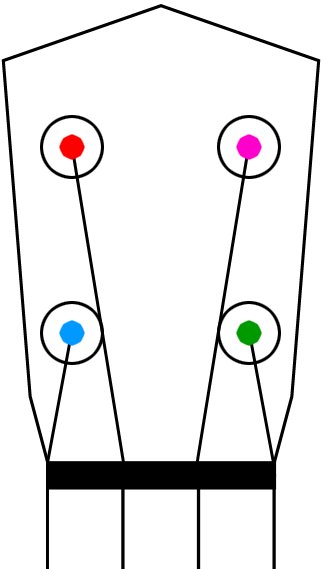
How to Use This Online Ukulele Tuner Tool to Tune
Tuning the ukulele is the most important skill for beginners to develop.
In fact, tuning is the number one thing you can do right now to sound better as a ukulele player!
In this quick-start guide, I cover the following topics to help you use the online ukulele tuner above:
- The Fastest & Easiest Way to Tune
- How to Tune Your Ukulele With a Chromatic Tuner (Video)
- How to Tune Your Ukulele By Ear With This Online Ukulele Tuner
- The Different Types of Ukulele Tunings
- Where to Get the Full FREE Ultimate Ukulele Tuning Guide
The Fastest & Easiest Way to Tune
Using an online ukulele tuner like the one above is a quick and dirty way to tune but tuning by ear is hard for most beginners (I explain how to tune by ear below).
Heck! I've been playing ukulele for over twenty years and it's still difficult for me to tune by ear!
Even online tuners that use your microphone can be inaccurate and buggy.
The fastest and easiest way to tune your ukulele is to use a chromatic ukulele tuner that attaches to your headstock and automatically listens/detects the pitch.
Because a chromatic tuner is a physical piece of hardware that clips on directly to your ukulele and listens to the vibrations, it's the most accurate way to tune.
My top choice for a chromatic ukulele tuner is the Snark SNX6 ukulele tuner.
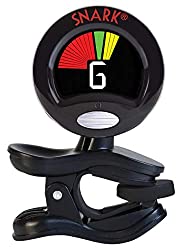
Watch me demonstrate how to tune your ukulele with this exact tuner in the following video.
How to Tune Your Ukulele With a Chromatic Tuner (Video)
In this video lesson, learn how to tune your ukulele with a chromatic tuner, like the Snark mentioned above.
This tuning method works for almost any ukulele including soprano, concert and tenor ukuleles.
With the aid of a chromatic tuner, you can quickly identify if you are sharp or flat (aka "too high" or "too low" in pitch) relative to the desired note. I prefer a chromatic tuner like the one above that clips on to the headstock of your ukulele.
By the way, did you enjoy that video lesson? If so, sign up for free to my email newsletter where I send you more video lessons like that one. Today if you sign up I'll send you my free 45-page ukulele lesson book Your First Ukulele Lesson and Then Some teaching you how to play your first songs on ukulele.
To get a free copy of the digital lesson book delivered to your inbox, just enter your email below:
Yes! I want the free ukulele lesson book Your First Ukulele Lesson and Then Some.
Please note: I take your privacy very seriously. I promise never to spam you or distribute your email to a third party.

“Thank you so much for these wonderful lessons. I have been inseparable from my (new to me) ukulele and am beyond thrilled that these lessons are allowing me to learn how to properly play it. I can tell that this relationship with my ukulele is going to be a lifelong bond. I can’t wait until I am experienced enough to play and sing songs to my 3 children. They have, thankfully, been enjoying the (nearly nonstop) strumming and lovely sounds being produced by my beloved new little friend. And that is thanks to you.”
– Lydia C., Student
How to Tune Your Ukulele by Ear With This Online Ukulele Tuner
To tune your ukulele by ear, like by using the online tuner above, listen to the pitches as a point of reference for tuning each string of your uke. If you have a standard set of ukulele strings, make sure Standard Tuning (gCEA) is selected on the tuner.
Let's tune the ukulele's top string first or the 4th string. Click the "Play" button under the "g" note to hear the pitch.
Please note you can change the sound of the ukulele tuner using the second menu below the tuner. The two options for audio playback are:
- Ukulele Sound
- Sine Wave Sound
The sine wave sound will be the purest, most correct reference pitch whereas the ukulele sound will have slight imperfections due to the natural sound of the instrument. Some players find it's easier to tune by ear to a sine wave reference pitch.
As the sound is playing (as long as the "Play" button is activated the sound will keep looping), first, hum the note and get it in your head. Once you're certain you've heard the pitch, pluck the top string, or the g-string (4th string), on your ukulele. Now, get this pitch in your head.
If the pitch of the plucked string is higher than the pitch of the sound playing on the tuner, that means the string on your ukulele is sharp.
If the pitch of the plucked string is lower than the pitch of the sound playing on the tuner, that means the strings on your ukulele is flat.
Audio Example of Incorrect Tuning
As the pitch of the reference note and the pitch of the string are ringing, turn your tuning peg on the ukulele to match the reference pitch. When the pitches aren't matching, at the initial attack of the two sounds, you'll hear "warbly" or "wobbly" sound between the two pitches like this:
Audio Example of Correct Tuning
When the pitches match, the warbly sound will be gone and the two sounds will ring out "smoother" against each other like this:
If you hear the pitches sound like this, then, that means you're in tune!
Follow the above steps for the other strings.
The Different Types of Ukulele Tunings
From the menu above (below the Ukulele Tuner), you can select from the following most common ukulele tunings:
- Standard Tuning (gCEA): The most popular ukulele tuning with a top high g-string that is higher in pitch than the middle two strings.
- Low-G Tuning (GCEA): This popular tuning is just like standard tuning but uses a top low g-string tuned down an octave expanding the ukulele's lower register.
- Whole-Step Up (aDF#B): Just like standard tuning but every string is tuned up two semitones or one whole step.
- Half-Step Up (g#C#FA#): This tuning takes standard tuning but every string is tuned up just one semitones or one half step.
- Half-Step Down (f#BD#G#): Take standard tuning a tune down one semitone or one half step.
- Slack-Key Tuning (gCEG): Almost identical to standard tuning except the bottom A-string is tuned down a whole step to match the top g-string.
- Baritone Tuning (DGBE): Baritone tuning requires a special set of baritone ukulele strings and is tuned like the bottom four strings of a guitar.
Where to Get the Full FREE Ultimate Ukulele Tuning Guide
For more help with tuning, check out my complete in-depth ukulele tuning guide to explore how a ukulele is tuned.
Disclosure: As an Amazon Associate I earn from qualifying purchases. Proceeds are used to support this site.
Not sure where to go next? Grab the free ukulele lesson book.

Join over 50,000 people and get our free ukulele lesson book Your First Ukulele Lesson and Then Some. Learn new tricks like:
- How to properly tune, hold, and strum your ukulele
- The most essential "must-know" ukulele chords
- How to play 3 extremely versatile strumming patterns
- How to play "I've Been Working On the Railroad"
To get a free copy of the digital lesson book delivered to your inbox, enter your email below: