
Being able to read music is an extremely powerful skill.
For myself, growing up, I played piano and ukulele. I relied very heavily on my ear to learn how to play songs. I’m very thankful for my ear, but this really limited me in the types of songs I could play.
So, for example, whenever I would visit my grandparents, it wasn’t uncommon they would want me to play a hymn on piano for them, or if it was around Christmas, a carol. They would put the songbook in front of me, and unless I knew the hymn or carol from memory, I would freeze or have to fumble my way through it.
Whenever I looked at a piece of music, I was completely intimidated by it.
How to Read Music
Looking at the sheet music of a song you’ve never played or heard before can be a little overwhelming, but it shouldn’t deter you from learning the song.
After this post, you’ll be reading music like a champ.
The Musical Staff & Notes
A piece of written music is built on the staff. The staff is a set of five horizontal lines that run across the page of a sheet of music.

Musical notes are placed are either right on the lines or in between the lines.

Notes that fall below or above the staff are placed on ledger lines.

Treble Clef & Bass Clef
Notes placed higher on the staff are higher in pitch, while notes placed lower on the staff are lower in pitch. Makes sense.
Note values are represented by the first seven letters of the alphabet: A, B, C, D, E, F, G.
Where these note values are placed on the musical staff depends on the clef. There are two types of clefs: treble and bass.
The treble clef is represented by a big “G” shaped letter at the beginning of the staff. As ukulele players, we will be frequently using the treble clef to read music.

The bass clef is represented by a curve with two dots to the right.

If you’ve ever seen a piece of piano music, the bass clef is written below the treble clef. Instruments that play in a lower range like a bass guitar, trombone, or tuba will use the bass clef as well.
Note Lengths
As seen above, the position of a note on the musical staff determines its pitch. There are different types of notes to determine the duration or how long a note is played.
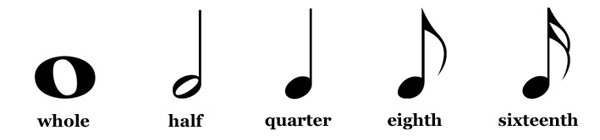
A whole note is the longest note sounding out the entire duration of one measure.
A half note is half the duration of a whole note. This means two half notes = one whole note.
A quarter note is half the duration of a half note. This means two quarter notes = one half note; or four quarter notes = one whole note.
An eighth note is half the duration of a quarter note. This means two eighth notes = one quarter note.
A sixteenth note is half the duration of an eighth note. This means two sixteenth notes = one eighth note; and again, to take it even further, four sixteenth notes = one quarter note.
These are the most common note lengths.
Time Signatures & Bar Lines
As you can see, there is some math behind playing music. Whenever you play a song, the song is based around a consistent timing structure.
This count is dictated by a time signature.
A time signature is a pair of numbers at the beginning of a song that lets you know how a song is counted.
Here are some common time signatures:

The number on the top tells you how many beats there are per measure. The musical staff is separated into measures with vertical bar lines.
Take a look at this example. This is the first four measures of “Twinkle, Twinkle Little Star.”
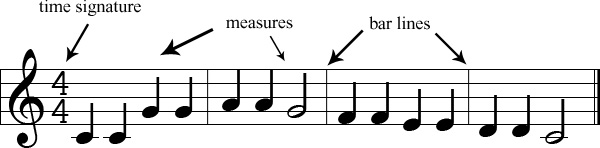
The number on the bottom tells you what kind of note length each beat gets.
For example, in a 4/4 time signature, the most common time signature, there are four beats per measure and each beat gets a quarter note in length.
In a 6/8 time signature, there are six beats per measure and each beat gets an eighth note in length.
The most important number is the top number because that tells you how you count the song.
Rests
Some of the most effective parts of a piece of music can be when the music stops and nothing is played at all.
When you look at a piece of music, you might see some rests. When you see a rest, that means don’t play!
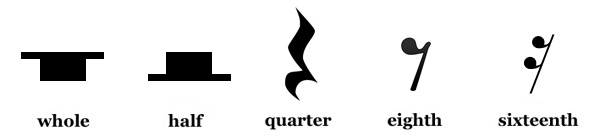
Rests have equivalent durations to other regular notes.
That means when you see a whole rest, you rest for a measure.
When you see a half rest, you rest for half a measure.
When you see a quarter rest, you rest for one beat.
When you see an eighth rest, you rest for half a beat.
And when you see a sixteenth rest, you rest for a quarter of a beat.
How to Put All This Into Practice
By now, you’re pretty well equipped to look at a piece of music and have a sense for what’s going on. You might print off this page so you can refer to it later.
There are still some things we haven’t discussed like key signatures, dots and ties, and accidentals (sharps and flats). I want to save some of these things for future posts where there will be more application of all this theory.
Right now, this is just head knowledge, but I really wanted to do this post because I’ve been getting a lot of requests for more fingerpicking lessons and songs, and in order for me to teach those, we need to make sure we know how to read music.
While I’ve done lessons on fingerpicking Leonard Cohen’s “Hallelujah” and fingerpicking the 12-bar blues, what I get asked most about is solo fingerpicking songs–songs where you can fingerpick the melody of the song without singing.
To teach and demonstrate these songs, we need to make sure we have an understanding of some of the basics of reading music.
Next week, I want to look at a really simple song we can fingerpick on the ukulele and exercise our newly acquired music reading skills.
I can’t wait to get more into this stuff with you all. It’s going to be fun!
Your Questions and Comments
Whenever we’re looking at music theory, I know there is bound to be questions and input. Don’t be shy. Post your comments below!
Looking forward to this! Thanks Brett
Now we are talking, Mister. This is the start of some really important information that you teach very effectively. I’ll be back for more!
tks for this and other lessons its a bit above me just yet but getting into it im busy learning the circle of fifths just now
Having just finished a music theory course I found your article to be to the point and not too much to absorb at once. This is a subject that has a lot to it and can become overwhelming, very easily.
Looking forward to your next.
Thanks for your feedback, Tom. I was a bit nervous about doing a post like this just because it’s easy to go off in the deep end really quick, but I knew that if I was going to be incorporating a little bit of written music in my future lessons, I’d need a post to refer back to.
Looking forward to getting into this more as well.
Brett, where in your book – or elsewhere – is it explained how one understands the use of Roman numerals? Thank you.
Hi Bud, I have a lesson on transposing chord charts that dives into the use of Roman numerals here: http://www.ukuleletricks.com/how-to-transpose-a-song/
Once again crisp clean info… fantastic!
Awesome. Thanks for your comment, David!
Hi Bret, I am a very new and keen uke learner. I also have always wanted to learn how to read music, but it always seem too daunting. Now you make it so doable because you give a reason to learn music literacy and a journey to go on. I will most deffinately order your online video course. Thank you
I’m really happy to hear you found this lesson beneficial! To your continued success! Cheers. 🙂
Thanks love all your music and tricks thanks for info
Help! I am trying to learn basics of music but am having problems with the Circle of Fifths as well as how to figure out the major chords. I know the major chord is the 1st, 3rd and 5th note. But when you identify those three it doesn’t match the chord illustrated. What am I doing wrong?
This is a hard question to answer in a single comment, but I’ll do my best!
While it’s true that a major chord is built on the 1st, 3rd, and 5th notes of a scale, it’s also true that a minor, augmented, and diminished chord is built on the 1st, 3rd, and 5th notes of a scale.
For example, a major chord… between the 1st and 3rd there is an interval of a major 3rd which is equal to four half steps between the notes. Between the 3rd and 5th, there is an interval of a minor 3rd (three half steps).
On a minor chord, it’s flipped around, because you actually drop the 3rd a half step. So between the 1st and 3rd there is an interval of a minor 3rd and then between the 3rd and 5th there is an interval of a major 3rd.
Hopefully I haven’t confused you too much, but essentially, all triads are built on the 1st, 3rd, and 5th scale degree, however, the 3rd and 5th can alter the type of chord. I wonder if this is the problem you are running into. I wrote a post about this here explaining the different between different types of chords:
http://www.ukuleletricks.com/major-minor-diminished-augmented-chords-explained/
Feel free to post any other questions you might have! I love talking about this stuff.
I am just a little bit confused. How do you apply this to the ukulele?
Hey Ryan, it’s important to be able to know the basics of reading music if you want to learn how to play fingerpicking songs like these:
http://www.ukuleletricks.com/ukulele-fingerpicking-nursery-rhymes/
I am so happy to have found you. I just purchased a ukulele at 64. I have always wanted to learn to play and I am determined to succeed. I am really enjoying your website. There is so much more information provided then I thought. Thank you for being out there.
Welcome to the world of playing ukulele! It’s great to have you here.
This is great, I have just started to learn finger picking.
Thanks thanks
That’s great, Norah! This is a good place to start.
this made it so much easier than trying to memorize the “Every Good Boy Deserves Fudge” and that kind of stuff that alternates lines and in the end just gets more confusing. I think you’ve made it a lot simpler by just putting it down clear cut! Thanks for the awesome website!
Hey Zach, I’m glad you found this so helpful!
my husband bought an ukulele and i though let’s give it a try. I’ve learned how to read music cos i played the flute for 8 years when i was little. I could only play the flute by reading the notes, I never memorized songs. I’m trying to learn the notes on the ukulele now and wanted to start with twinkle twinkle little star. When I read your music for that song i notice there are some double written notes, that confuses me. can you explain a little what to play there and what note(s?) to read? I realize that i’m starting to memorize the song without reading the notes.
Thanks in advance
Hi Lilian, those double written notes are notes that are sounded at once to create a “chord.” This adds harmony between the notes and creates a fuller and more interesting sound. On those pieces of music, be sure to look at the tab to see how to play those notes on the fretboard. If there is a specific measure in a song that you have a question about, just let me know and we’ll take a look at it.
Tanx men, i look forward to hearing from u
I just purchased a ukelele and will be using it in my preschool class with children. I was watching you play twinkle, twinkle and was wonder how to read the tabs. I know how to read music but i don’t know to play guitar or ukelele but im very determined to learn how.
Hi Wendy,
You can check out a lesson reading tabs here:
http://www.ukuleletricks.com/how-to-read-ukulele-tabs/
hi i’m John from the comment above
i had read this: http://www.ukuleletricks.com/how-to-read-ukulele-tabs/
but the thing that i don’t understand now is how it is played when it only has 0’s in the bar e.g the first bar of twinkle twinkle little star: http://www.ukuleletricks.com/media/music/twinkle-twinkle-little-star.pdf
Hi John, 0’s represent open strings. When you see a zero, pluck the string without fretting any notes.
Thanks a lot man! It’s for people like you, we can learn these staff while sitting in the couch. Thanks again.
Is there an alternate way to form the E and Bm chords? I have really short fingers and can’t seem to make my pinky reach. Also, in the strumming when you are using your index finger on up down etc, do you use your thumb at all, or just your index finger? My index finger keeps getting caught in the strings on the down strum. Do your thumb and index fingernails need to be especially short for the strumming?
Kim, great questions. For alternate positions, check out the chord library here:
http://www.ukuleletricks.com/ukulele-chords/
E is just plain tough and requires a lot of time and practice. You might consider just barring the top three strings at the 4th fret and muting the bottom string. This requires less stretch. For B minor, in some cases, Bm7 works and sounds just as well and requires you to just barre all of the strings at the 2nd fret.
For the strumming, I find my index finger gets caught up on the down strums when I’m using too much of the side of my index finger. Try focusing on strumming more with the nail side of your index finger. Just so your nail slips across the strings. For my down strums, I’ll often combine my index finger and middle finger, and even ring finger for the down strums, using the nail side of those fingers. I can’t imagine shorter nails will provide much benefit, assuming they aren’t ridiculously long or anything, so you should be good there.
Hi Brett , looking at your how to read music , i have a question regarding reading music for the ukulele. I understand how you play chords , i understand playing single notes while reading tabs. But how do you play single notes on the ukulele while reading music , If say i want an F note i know if im playing a chord where to place my fingers and strum down, but how does this work when on single note form , where to place fingers and what string to pluck . Many thamks . Mike
Excellent question, Michael. To learn how to read music and know what note to play on the fretboard, it takes some practice and requires you to have a good grasp of the notes of the ukulele fretboard. To learn the notes of the ukulele fretboard, I recommend starting by learning major scales. Start with the C major scale:
http://www.ukuleletricks.com/how-to-play-a-c-major-scale-on-ukulele/
The tricky aspect about learning the notes on the fretboard is figuring out which note corresponds to which note on a music staff on a piece of sheet music. The reality is that the same note can be played in multiple spots on the ukulele fretboard. I dive into this on a much deeper level in Part IV of my book Ukulele Exercises For Dummies. If you have an interest in the topic, it would be the next best step.
mercie une ami Bert, i love ur lessons
We need a tutorial for people who can all ready read notation for another instrument (piano violin etc)
and want to read notation for ukulele. The tutorials are usually written for players who don’t know notation.
Most guitar and uke players just memorize chords as geometric patterns on the fretboard and don’t know the notes. “What’s a G chord on the uke?” “It’s a triangle just like the D chord on the guitar” I say that the D chord is a triad of three notes (d, f# and a). A D chord could be played on three clarinets. “What note is that?”
“It’s the ring finger on the second string at the third fret” I say It’s a g note played on the e string.”
Hi John, indeed, this lesson is written for complete beginners. If you’re already familiar with reading music, I highly recommend checking out my book Ukulele Exercises For Dummies which include some more intermediate exercises and instruction. In the book, I include music notation for those that read music alongside tab, which is easy to read for beginners.
I am a teacher by profession and have put together a methodology for teaching “real music” using ukuleles.
Memorizing chords as geometric shapes is like memorizing sentences in a new language and not knowing the meaning of the words. If you know basic chord theory (which notes make the chords) you can remember the chords and create chords that you need.
Hi Brett
I have just finished a Lutherie course where I made my own tenor ukulele out of rare timbers. It is beautiful, it sounds great and I am so proud of it…..now… time to learn how to play it !! I don’t have a musical background and tried to learn guitar but found it a little cumbersome to play comfortably. Reading through your “Start Reading Music ….” info gives me great confidence to begin on a great musical journey with my uke. Your a great philanthropist for offering a free e-book. Well done to you and thanks a million. Cindy
Brett,
Two questions about notation.
1) When is a BEAM connecting the tops of two or more notes used? Exactly what implication about playing the notes does a BEAM signify, if any?
2) How do you know when to hold a fretted note as opposed to releasing the fret after its indicated length?
Never sure whether I should hold a chord shape after I have played the individual note and going on to pick the next individual note..
I find a little more complex fingerpicking song arrangements to be a lot more interesting to me than just the melody and/or strumming patterns, although strumming patterns are always welcomed.
Thanks for all the hard work you put into your site.
……………..one happy member
Hi John,
1. When a beam connects notes that are “stacked” on top of each other, this indicates a chord. Essentially, you perform all the notes in the music staff at the same time. In the case of the ukulele, you would pluck or strum the notes in a chord at the same time.
2. This is all depends. Typically, in a fingerpicking piece, you let a note you pluck on a string ring out as long as it can before you pluck the next note on the string. The ukulele has a rather fast decay, so for the most part, you don’t have to worry about notes ringing too long.
Great questions!
Can you take a photo of each type of note a write underneath what they are
GREAT ANYWAY! I LIKE IT I GOT A FEW THINGS I DIDNT KNOW! Thankyou
Thank you for so generously teaching. I haven’t read music sine I was a teen and was shocked that I had forgotten the basics. Great job explaining! My first ukulele arrives today and you’ve got me really excited to start learning at my own pace! Thank you, Brett!
Hi Brett, thanks for the great information you have given on music theory. I am a young organist and solely play by ear. I have no problem playing chords or pedals, but am in a similar situation to you when you were younger regarding my ability to play music directly from sheet. I have a good idea of where all the notes are on the sheet music and can play them individually, but when I am trying to read from note to note I struggle todo so and have to look at the keyboard to see where I am! If I know the first note of the piece and know the melody I normally just use my ear to figure out the rest of it. How do u suggest I could improve my music reading skills, as I know it would be hugely benefical? Thanks in advance – Eoghan
Great question, Eoghan. The best way to become a better sight reader is to start digging into sheet music and learning songs from sheet music. The best sight readers are those that have spent a lot of time reading sheet music. I find that the songs I have learned from sheet music I end up memorizing measure by measure, so I can focus on what my fingers are doing. Then, I just might have the sheet music in front of me for reference.
On the other hand, some people are sight reading machines, where they can sit down and play a piece of sheet music in one sitting, but this isn’t very normal unless the pieces are fairly simple.
Thanks Brett! Very helpful as always 🙂
i just came across this, but have been wanting to learn this stuff for a while! bam! the basics! i cant thankyou enough, this information will do my life well x
I’m a new ukilele player and I have played guitar but I’m SO confused I mean I get the basics but like o look up a song on the Internet for uke and there is either chords with lyrics which I don’t like because I don’t sing or there is confusing notes. Like in guitar there is like note Reading were you put on finger on a fret and you just strum that one string I really like that but is that even a thing with Ukilele? Please help
Hi Madi, I think you might be talking about ukulele tabs. Most fingerpicking or fingerstyle ukulele music will have ukulele tabs, such as those in this beginner fingerstyle lesson here:
http://www.ukuleletricks.com/ukulele-fingerpicking-nursery-rhymes/
It says that all the notes according to each line, but what are the notes that go lower than the line? Thanks, I am just teaching myself how to play uke, and I am only usually good at clarinet and do professional singing lessons 🙂 Great website!! –greatful 14 year old girl 😀
The notes below the music staff are placed on “ledger lines” in sequential order depending on if you’re going up or down in pitch.
Hi brett I love your lessons. My questions is do you have anymore lessons on learning how to read music. I have a basic understanding from other teachers I’ve had but I’ve learned more from you in couple of months than I’ve learned from the teachers that I’ve had for years. This is something I would be willing to pay for. Or maybe you have some suggestions on where I could obtain this knowledge.
I’m so glad you’ve enjoyed the lessons and are learning so much! At this time, I don’t have more instruction specific to reading music. I’ve found that this website here does a pretty good job with music theory and reading music.
I am so impressed at how engaged you are, and the simplicity in your efforts and lessons. Thank you so much for helping me learn to play!
Hi Brett,
I am at the beginning stage of learning how to play the ukulele. I just wrote down all this info into notes for myself. I also signed up with my email to start learning by your videos. I just wanted to know if all this information gonna help me learn the strumming patterns of each song I want to learn? I don’t know if that makes sense or is a stupid question hahah but I didn’t want to waste my time or yours if it’s not for the right things. Thank you.
Indeed, it does help! Reading music isn’t critical when learning to strum chords and songs on ukulele in the beginning stages, but any sight reading ability you are able to practice and work on now will always help. The lessons I send to you in the Learn to Play Ukulele Today course are designed to be step-by-step. I would recommend in the beginning to focus your practice on the steps that I provide. Of course you can dig into these other lessons too but if you ever start to feel overwhelmed, it’s okay just to focus on the objectives I outline in the lessons. Let me know if you have any other questions!