
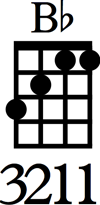
 A common question I see in the Strumming Tricks video lesson course, as well as in email, is about how to play a Bb chord. If you aren’t familiar, a Bb chord is played on the ukulele as shown in the diagram to the left.
As normally instructed, to play a Bb chord, use your index finger to hold down or barre the bottom two strings of the ukulele at the 1st fret; place your middle finger on the 2nd fret of the third string and your ring finger on the 3rd fret of the top string, as shown in the following picture.
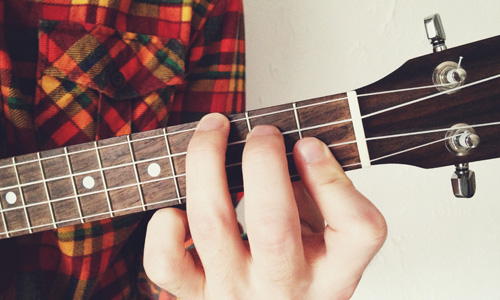
A common way to play a Bb chord
This position requires you to bend your index finger in what can seem like a really difficult and uncomfortable way. If you struggle with stiffness or even arthritis in your fretting hand, this position can seem near impossible. Not to mention, this way of playing a Bb chord requires quite a bit of strength.
In my conversations with you, a lot of you have found an alternative way to play a Bb chord that works extremely well. To play a Bb chord, rather than barring only the bottom two strings at the 1st fret, barre all the strings with your index finger. This means, you hold down all four strings at the 1st fret with your index finger. Then, position your middle finger on the 2nd fret of the third string and your ring finger on the 3rd fret of the top string. Check out the following picture to see a Bb chord played in this alternate position.
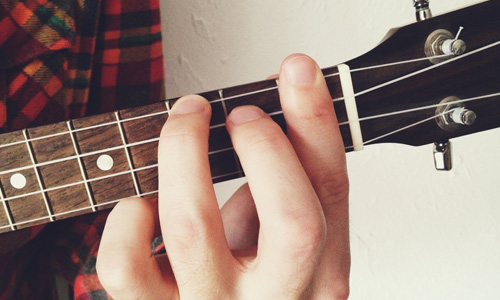
An alternate way to play a Bb chord
Note: Ensure the end of your thumb is firmly planted on the neck of the ukulele to provide leverage and support.
The benefit to this alternate position is that you are able to keep your index finger extended, rather than bending it in an awkward way. Many find this much more comfortable, and because you are using the entire index finger to hold down the strings, the amount of strength and energy required to fret the strings is a little less.
I want to hear from you. How do you play a Bb chord? Any tips that you have for your fellow ukulele players? Post your comment below!
I use the second method on playing the Bb cord. It is more comfortable for me to bar the whole fret. Also, If you move that shape to other frets you can get other cords. So, it is easier to move to other cords. For me the easier transition is a real benefit.
Dave, I’m so glad you mentioned that. You can definitely slide the chord up the fretboard to play other chords.
For other readers, for example, if you move the Bb chord position up two frets, you are playing a C major chord. If you move the Bb chord position up four frets, you are playing a D major chord. Pretty cool.
The most easiest way is to not finger or play the first string when playing Bb. Simple!
Interesting, I will try that. I find Bb and Eb a real pest. I think Bb in particular because it is so close to the nut its hard to press and get a good clear sound. I play a 4 string plectrum banjo and barring chords is easier on that!
Did you re-string your banjo to Uke strings (GCEA)?
Jim
Brilliant! Thank you.
The comment by Jan Brne was for Bb by Ukulenny. We saw that it included F, D and Bb and it got a big hooray from me.
Cheers.
the tip of my 2nd finger on my left hand is bent to the left, which seems to be the wrong way with most chords,trying to over come this, and appreciate not playing the first string in Bb, and F ,D..
BIG hooray from me too!
wouldnt it e great if C7 on the first string was Bb like IT SHOULD BE !!!
Hah!
Can you play the same strum for C2, B, C2?
Mitzi
Hi Brett, because of my inability to barre properly(my index finger goes diagonally across the fret, not an excuse, just a reason after an accident whilst at sea) I find with the Bb is easier for me by holding the finger closer to the nut, and then putting pressure on by laying the next finger atop of the index (as if crossing the fingers for luck) and pressing down onto the index finger, and of course pressure from the thumb against the back of the fret board. Complicated, ha ha, it works well for me.
I agree with you both about playing the Bb with the barre. However, the barre might be harder for some beginners to play and master. I’ve found with daily practice, about 10 minutes a day, you can master the barre and make it a part of your everyday playing. Brett, do you have any exercises to strengthen playing of barre chords?
I agree with you the barre takes time for a beginner to master. Like you mentioned, one of the best ways to strengthen your fingers, hand, and wrist is to intentionally practice chords (such as setting out 10 minutes a day). For barre chords (and chords in general), building strength throughout your hand is important. Positioning helps, but if you lack the strength, it’s going to be hard to hold those barre chords for extended durations without experiencing soreness.
If you’re looking for exercises apart from practicing chords, there are two I can recommend. For the first one, I recommend using a tennis ball or a stress ball. Hold the tennis ball in your hand, squeeze it with a tight grip for 5 to 10 seconds, release for 10 seconds, and repeat a few times.
For the second exercise, take both of your hands and put them together as if you’re praying. Separate your hands slightly while allowing the tips of your fingers to touch. In that position, press against each hand with a moderate to high amount of pressure for 5 to 10 seconds, release for 10 seconds, and repeat a few times.
Both are pretty simple, but they work the same muscles that you would use when fretting a chord. These exercises can be nice way to practice when you aren’t able to play you’re ukulele. And remember, don’t overdo them either.
super useful exercises, I’ll get practicing tonight! thanks 😉
I use the second method it allows me to slide up to a C nice and easy or a barred G
I find it impossible to finger as per all the diagrams I have seen. I have to keep the top joint of my ring finger vertical to avoid buzzing the 3rd string. This leaves me having to bar the 1st and 2nd strings with the bottom part of my finger. This is impossible. BUT I have found the perfect answer. I fold over my forefinger and bar the 1st and 2nd strings with the back of my finger . Easy peasy !
I like your ingenuity! Good work!
Brett, could I see a picture diagram of what Martin Hignett is talking about? I have small hands an his method might work for me although I think with time I maybe able to master the bar chord.
Wow, this could be the way forward for my short jointed little fingers. Does it mean you have the nail and a bit below against the strings?
Oh my goodness, thank you!!!
Worked instantly for a beginner. Thanks
Thanks Martin for the tip about bending forefinger over to play Bb. It worked instantly ;and for the first time I can get a decent sound for that chord:)
i just tried that and it worked and sounded great! Thank you for sharing! 😀
I really would like to play Bb easily, but I have no idea what you mean by “folding over your forefinger.” Could you please explain further?
Oh my goodness this chord has been bugging me for MONTHS and no matter what I’ve tried, I can’t do it.
I tried out using the back of my finger and it worked amazingly! Thank you thank you thank you!
7-5-6-5 works well, too, although it takes you into a different register. If you’re playing fingerstyle, you can just go with 7-5-6-x and still end up with a Bb on top, also.
Great tip!
???? What do those numbers mean?
Brett, can you explain a bit what 7-5-6-5? i am just too new to this. thanks.
Hi FJ, “7565” is a bit of shorthand to describe a chord position. Each number represents the fret number. From left to right, the number at the very left represents the top g-string of the ukulele and the number at the very right represents the bottom A-string of the ukulele with the middle two numbers representing the C-string and E-string.
This is my “goto” Bb shape, also recommend trying Bb6 (3535), even easier though the “jazzy” sound might not work for all songs
Hi Brett
Thanks for your tips on Bb chord. I struggle with this – using the first method. I have tried the barre method but my fore finger has very little ‘padding’. I even thought of putting some sort of ‘sleeve’ over it to give me more pressure!
Cheers
Polly
I find this barre technique really good if the next chord is Bbm. Just lift the middle finger.
It depends on where I’ve been and or where I’m going with the next chord. The big issue when playing a Bb the traditional way is to get your hand and wrist forward. If you scrunch up on the chord, you will most likely chunk some of the strings.
Thanks, useful to have alternative chord shapes . In my experience some people can do bars straight away, purely becasue a uke is so small, some need time and practice. As well as describing the fingers and strings involved, I find it useful to add the ‘principal’ behind this alternative Bb, i,e, that you are shifting a standard A chord up half a step by barring the first fret. and playing an A chord position on the second fret. By doing so, learners inherit a general way of finding alternative chord shapes, and changing key chords, by being a human capo!
Great comment and insight, Ginny! Thank you for addressing this really useful principle.
That’s unbelievable. That’s the first piece of “fret” theory that’s actually made sense to me. Now I see how a chord can be “moveable” Thanks Ginny. Meanwhile, I still can’t hold down the barre. I’ve even tried just strumming the first three strings because the last note is another Bb anyhow ….
HI Brett I use a variation on both types I place my index finger on strings 1&2 then strengthen by placing my 1st finger over the top of index, then use ring finger on 3rd string and pinky on 4th string. I find this system works well for Bb, B , C, C#.
Like the lessons
Ray
I have arthritis and have struggled getting a clear tone from this chord for a long time, but Ray’s idea really works…thank you for posting this!!!
Wait – I just found something that works using what Ray just said. I’m playing a concert. I put index finger on string 1 1st fret, middle on string 2 1st fret, ring on string 3 and pinky on ring 4. FIRST TIME I’VE EVER PLAYED THIS CHORD CLEAR….WOW. Thanks so much for sharing ideas – I would never have thought of this. It obviously helps that I can fit both fingers into that first fret. And for some reason it works better for me than Ray’s method.
Laurel good tip i am going to try it Thanks
Yes Laurel I can play the chord best this way (my hands are becoming arthritic).
Another advantage to the full barre method of making Bb is the easy transition to Bb7 by lifting your ring finger.
Great tip!
Of course playing Bb barred is very advantageous as one can slide up the fretboard to get other chords, but most of the time I play it by pressing the index finger on the first fret of the second string, and the middle finger on the second fret of the third string. Yes, only just like that. I understand it contains all the harmony notes required. Learned this from several reliable music gurus on You Tube. Makes life very simple in many chord progressions. Hope this helps.
This is valuable advice to me. Thanks.
You people are so awesome. All these barre tips will my make uke learning considerably easier.
I just asked for some help with Bb at my local shop and the instructor there helped me by changing where my thumb was pressing on the back of the neck and the angle of my hand. I tend to focus mostly on where my fingertips are placed and forgot that without the right leverage against the back of the neck my finger tips couldn’t exert enough pressure. I’ve started re-evaluating my hand and thumb position for several other chords to see if I can refine my grip there too, rather than just trying to force a position that wasn’t working like I was in some cases.
Great insight, Alan. Thanks for the comment!
Thank you Brett. Very good lesson. My tips for the barre chords: 1. make sure the uke has soft strings and quite close to the fretboard so it is easy to press them. 2. press with the bones of the fingers not with the flesh. 3. place finger so that it covers the fret a little beyond the fretboard, I mean higher up; in this way the finger has more strength. 4. last but certainly not least: DO NOT place it straight but bend it slightly to one side or another according to the chord changes for the song. When I bent my finger slightly to the left I discovered that it was easy to barre.
Excellent tips, Stefania! Thanks for your comment!
Brett, what a godsend for arthitic hands. This tip makes a huge difference.
Thanks. Buff
Well…for anyone getting discouraged, it took me 10 months to be able to fret the dreaded Bb, another 4 months to do it with the barre. I had to learn to barre it as the whole reason I started playing the Uke was to one day play Iz’s “White Sandy Beach”. Little did I know his love of the Bb and Bbm chords in this song, as well as several of his other songs.
The good news: I can now play these chords clearly. The bad news, it takes me 2-3 seconds to get my fingers in position so I still can’t play the song …without long pauses. But hey, I’m still only 69. By the time I hit the 70’s I’m sure I’ll have mastered WSB and be a whiz at moving up and down the fretboard. :-).
The trick is, never give up. :-)).
Thanks, Brett for all your good info.
I too have real trouble with the Bb chord and its stopping me from playing one of my favourite songs properly and its so annoying. But I am taking the tip about placing first finger on first string first fret and second finger on second string first fret it seemed to work a couple of times but not after that so it must be a case of practice practice practise hahaha. I agree with Richard its all according where you are going with the next chord or even the one before the Bb chord as sometimes i cannot get there quick enough.
My 2 cents to add to confusion ! You might consider that “movable” chord fingerings (including the above Bb) are not set in stone : it may be more convenient or easier as the chord is displaced up or down the neck to use a complete across barre technique, only barre 2 strings, or to finger/fret all 4 strings, or leave one or two open, if possible.. The choice may become clearer when you know what your next chord is. I suggest that a way to open up this choice of fingerings is to play : C F G C chords (majors, minors or 7ths, whatever takes your fancy). Then play F Bb C F. Then try G C D G, and A D E A. Etc. You will see and hear that you will tend to look for the position and fingering which is the most convenient for going to your next chord.
I sometimes use 5123. Pinky at 5 then 123.
Any B chord position sucks; I’ve come to the conclusion it will simply take practice molding my fingers to reach some of these positions. As a former gymnast, it’s like retraining ones body to do the splits, once the body becomes less flexible. Painful but possible. 🙂
Here is a great exercise to strengthen hand and finger muscles. It was recommended to me by a first class trainer, and it really works. Start with a 2 lb dumbbell (or with a 1 and 1/2 lb jar of tomato sauce.) Hold the dumbbell by the end, or the jar by the lid, using only your fingertips. Hold your arms by your sides with the object over a pillow or something soft so when it falls the obvious wont happen. Hold the dumbbell or jar until it falls from your fingers. Slowly add weight (easier with dumbbells obviously) and hold for longer times. You will be amazed how strong your hand and fingers will become.
Thanks for the exercise tip, Julian!
Yippee I have just mastered the Bb chord. I started by cheating and playing Gm7 (instead of a Bb) which is bottom two strings first fret 3rd string second fret. I practised this on one song over and over and once i had mastered this i then realised i could reach the top string also for Bb. (third fret top string. It has taken me ages but i can get there now. I find also that if i twist my index finger on the two bottom strings it is easier to reach the the 3rd and 4th strings. I dont know if this will help anyone but it might help someone!
I’m a newbie and this chord was giving me absolute fits. Looked up every variation I could find and could not manage any of them. So I tried using all 4 fingers and voila. Good and crisp. I came to post this and saw that Laurel had tried and succeeded the same way. Maybe I will eventually master barre, but I am 64 and not as limber as I would like. This way works really well for stiff fingers.
I’ve also struggled with Bb, but my recipe was as follows. There are two things you can do.
Firstly, the string furthest away is 1 and the closest is 4.
(1) As a previous poster mentioned, play 3-2-1-Mute. Put 1st finger on 1st fret E string (2nd), 2nd finger on second fret C string (3rd), 3rd finger on 3rd fret of G string (4th). Now this is Bb if you don’t sound the 1st string. So you can strum all strings, deliberately let your 1st finger touch on the A/1st string, so it’s muted. Now you can play a Bb. BUT… Over time, your finger muscles will get stronger and when you’re ready, keep your finger in the same position put pressure down onto the A/1st string. You can then play a text book Bb.
(2) Put your index finger barring all strings of the first fret. Use your 3rd finger on 2nd fret of the C string (3rd) and 4th finger on 3rd fret of the G string (4th). Put your 2nd finger ON TOP of your index finger to allow you to apply double pressure. This is a guitar technique I learned many years ago.
Hope these help.
Like many, I was having a hard time getting a Bb to ring clearly. Barring the first fret would cause the bottom two strings to be weak. When I moved the same shape up the fretboard I was able to get clear sounds. That got me to looking at the first fret more closely. It appeared that the strings were too far above the first fret. After researching quite a bit I discovered there is a thing called the “action”. That is the distance between the string and the fret. Mine at the first fret was about 0.040” (1.0 mm). Ideally it should be closer to 0.032” (0.8 mm). I took my ukulele into the shop and had them adjust the action and make sure the frets were all on the same plane. Now that the adjustments have been made a Bb turns out to be fairly easy to play. So if you’re having problems with that chord, check the action on your ukulele. The problem may not be you.
Great comment on the action of a ukulele. Less expensive models tend to have high action. Specially if you haven’t had a setup done on it. Plus the tension at the nut is greater. As a test, try doing the chord shape up higher on the neck, 5-4-3-3 or 7-6-5-5 etc. Barre the bottom two strings as normal and see if you can get all the notes to sound clean. If you can achieve a clean sound here, but not at the 3-2-1-1 position, then that may be a sign of either high action, or that your hand needs strengthening. Or possibly a combination of both. Anyway, hope this helps.
I struggled with Bb until I swung the head of the uke outwards from my body. (This is next bit is an exaggeration ) almost make a ‘T’ shape with your Uke and body, this alters the angle of my wrist and fingers which enables a stronger use of the fingers. I watch guitar players and some of them swing their guitars out in front, hmmmm, wonder if they are playing ‘F’ which is the same shape is uke Bb.
what about playing an A chord at the 4th fret or a G chord at the 5th fret with the thumb deadening the G string
Do you mean like X565? Indeed that would work as an alternative position for a Bb chord!
It works for me with the slight modification in that I bend over my forfinger and bar the 2 strings with the side of my bent forfinger which is reasonally comfortable.
Thanks Chris
I just found out my fingers are small enough that I can play Bb using fingers 1-4 with finger 1 starting on the A string!! It’s a bit fiddly but works if I can hit it!
Nice one, Rach! I could never make that position work, but people with small fingers definitely have some super powers 🙂 glad you found this works!
oh my gosh so very interesting, thank you very much Brett and everyone. it took me some years to master the barre D7 chord. Now i am working on Bflat…ha ha i can play it ok now but still hard/ not yet possible to get onto it or off it moving to other chords…eg F, C7. I once found having a plaster on the finger helped to barre correctly! Great tips everyone. I will experiment with some different methods, maybe the fingers enjoy a bit of creativity! Happy comfy uking to all.
The Bb chord is difficult in part because the strings are quite high coming over the nut so it seems harder to press them all down at once behind the first fret. So, practice the barre Bb shape further up the neck, for example at the third fret. This forms a C major. Then practice it at the second fret (B major) then when working well, try it at the correct first fret position.
Great tip, Patrick! Thanks for sharing this.
I’ve just tried this on my soprano and IT WORKED! I might have cracked it :-D!
Hooray! Glad this helped, Annie!
Index finger on A string, middle finger on the E, ring finger on the C string and the pinky on the G.