

photo by alonis
What are scales? How does a scale work? Why are they important to know?
We’re going to tackle these questions. In this lesson, I want to take an introductory look to scales, specific to the ukulele. This little bit of theory is very helpful to know, and it’s pretty easy to understand.
What is a Scale?
In the simplest way, a scale is a collection of pitches, represented by the letters A through G of the alphabet, arranged in an ascending or descending order.
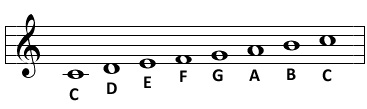
C major scale
There are many different types of scales (e.g. major, minor, pentatonic, etc.). The type of scale will depend on how the intervals are arranged between each note of the scale. An interval refers to how far one pitch is separated from another pitch.
The intervals we want to concern ourselves with are half step and whole step intervals.
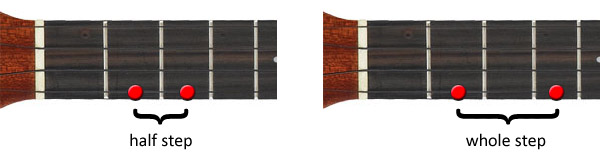
On the ukulele, if you play the note on the 2nd fret of the top string and you move up to the 3rd fret, you’ve went up in pitch by a half step. Every time you move up or down a fret you’re moving a half step.
If you play the note on the 2nd fret of the top string and you move up to the 4th fret, you’ve went up in pitch by a whole step, which is equal to two half steps. If you went from the 4th fret to the 2nd fret, you’ve went down in pitch by a whole step.
So How Does a Scale Work?
The arrangement of these half steps and whole steps in the scale gives it a particular quality (e.g. major, minor). Some scales possess larger intervals within them, but the most common type of scale in popular music is the major scale, which can be understood in a whole step and half step pattern.
The notes in a major scale are all separated by whole steps, except there are half steps between the 3rd and 4th scale degree, and the 7th and 8th scale degree (the 8th scale degree is the octave note of the first or root note of a scale). See how a C major scale is represented on the piano.
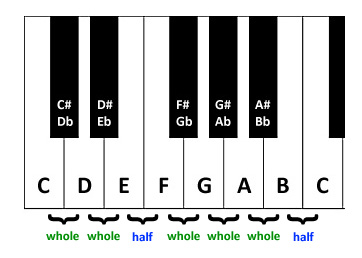
If we know where the half steps and whole steps are on a scale, we can construct any type of scale starting on any note.
For example, say we wanted to construct a G major scale. We can apply the half step, whole step pattern of a major scale starting on a G note.
If we go up a whole step from G, we land on A. If we go up another whole step from A, we land on a B note. Now, we need to go up a half step from B, which will put us on a C note. From the C, we’ll go up a whole step to the D. If we go up another whole step, we land on an E. And another whole step, we end up on an F#, and from F# we go up a half step to get back to G.
So in a G major scale, we have the following notes:
G, A, B, C, D, E, F#, G
When seeing and understanding the construction of a scale, it can sometimes be helpful to look at piano keys to see more clearly the half steps and whole steps between notes. One really great exercise is to construct major scales for all twelve keys.
Why are Scales Important to Know?
Having an understanding of scales allows us to have a framework for which to understand the chords or songs we are playing. Surely, you can play a song from a chord chart without having any understanding of the theory behind it, but if you’re writing your own music, or improvising over a piece of music, this knowledge can be really beneficial.
In addition, understanding scales can be really helpful when you consider adding different quality to your chords such as add9, maj7, diminished, min7, or sus4.
Final Thoughts
We’re only skimming the surface when it comes to scales, but before diving any deeper, it’s helpful to have a basic understanding. Ideally, you want to get to a point where you know in theory all twelve major keys and what notes are in each of these keys. You can start applying this half step, whole step pattern construction to any note to create a major scale. Give it a try and let me know how it goes for you.
We’ll be sure to look at this more in the future.
Are you lost or confused? What are your tips for understanding scales? Post your questions and comments below. Let’s hear it!
This is a great webpage!!!!
I am not sure if this book will be of interest but it seems to go well with this lesson.
Free Book: “Good Cats Eat Ants-II” – Revised Edition
Link to File (see below):
http://www.box.net/shared/g7h76cnf29
Paul, thanks for the comment! I’m glad you like the website. I’ve only been able to glance at the book you posted, but it looks really helpful. Thanks for sharing it.
Thanks, looks like a good share for those that want to go really deep into it
I’M SOO CONFUSED!!! i’m trying to learn the uke and i have never touched any instrument before so i am very confused…
Elizabeth, if you are just starting out, check out my free ukulele lesson book on the right hand column and work through that. It’s created for those who are really confused and don’t know where to start.
Great explanation – even though I don’t intend to ever write any music, it is helpful to me to understand where the music is “coming” from, and where it lives on the ukulele. I’m just starting to read music, and find this is really helpful; also, just starting to undestand where these notes live on the uke…also really helpful. Thanks, Brett, for this, the strumming lessons, the free book, everything. You are incredible!!!!
Sometimes use scales as a warm-up to get the fingers of the left hand working when first picking up the uke, and all goes pretty well when using the thumb of the right hand to pluck strings. And, to get the right hand working, try assigning the first finger to the 3rd string, middle finger to 2nd string, ring to 1st string. That’s when things get ugly. lol It’s as if my left hand suddenly can’t find the correct string or fret for the note I want to play, and my right hand doesn’t care to behave much better. Imagine it’ll get easier with more time. Thanks, Brett, for all your hints!
Beck, thanks for your comment! Scales are a great way to warm up that left hand. Also, great tip on assigning a finger to pluck each string. This is great fingerpicking technique. I found that assigning your fingers like this is really difficult at first, but once you get it down, it’s really great because you are utilizing four of your fingers rather than just your thumb or your index finger to pluck the strings. Great tips!
Thanks, Brett. Have only been playing the uke for a few months, and immediately wanted to be able to ‘play like Jake’ on this easy, four-stringed instrument. Have found it best to start with basics and hope for improvement in my playing every day with some pretty boring, but probably neccessary, practice on the very basic things, like scales, to make chord changes a little easier. You’re right, assigning fingers to a string to pluck is really hard at first and am still having trouble with it, but it is beginning to come together better with time and some practice.
Clear, concise, well done. This is written in a way that any reasonably intelligent person can understand.
Due to your explanation of the two semitones in each scale, for the first time ever I was able to play a scale on the piano from any starting key. It also came as a revelation to me that the keys between the black key sets (B,C and E,F) are a half tone apart. Very easy to remember, now that I understand the layout.
Thank you so much for taking the time to post this!
Bill Harris
You got it! When I took music theory in college they would teach us to remember that B & C and E & F are only separated by a half step. Glad that you enjoyed this lesson! 🙂
Hey Brett, Did your thumb ever really hurt pushing on the neck of the ukulele for the tricky cords or am I doing something wrong??
Hey Jamie, you might experience some soreness for those tricky chords at first. It can take a little bit of muscle to get those chords to ring out nice and clear. If you are feeling your hand get sore, just rest it and come back. Your strength will build up! 🙂
Thanks!
Hi Brett. Have you considered some lessons on instrumental music for those of us who can’t sing well? I finished the strumming lessons, which were really good and helpful. I’ve been messing around with trying to pick melody and combining strums, but it’s slow going. When do you use picking patterns and when do you play melody? Starting to get confused.
Hey Craig, I have thought about this quite recently actually. Right now, I’m looking for some good easy fingerpicking songs that I could teach. If you come across any that you want to learn or think would be cool to feature here on Ukulele Tricks, please feel free to email me.
As for your question, it’s a good one. Often times people will combine chords with the melody with a combination of strums and fingerpicking. The melody is usually played higher than all the other notes in the chord.
Brett. I bought Ron Middlebrook’s “Ukulele for Cowboys” and was messing around trying to finger pick the melody on Red River Valley and Home on the Range, probably without much success.
tks i had a smattering of knowledge on the scales but showing the piano notes was very helpful,tks for lessons
I’ve been learning to play for about 2 months. I started with a soprano but because the strings are so close together I’ve only used my uke to learns different chords and different strumming patterns/techniques. I know about 20 different chords now and am trying to become familiar w/ changing between them. I have a drill where I close my eyes or just not look at my uke and recite chord names and constantly change position strumming only once to test my hand position. I recently bought a Ibanez concert ukulele for more space between strings. I want to learn how to finger pick but am worried about my level of experience and tackling too much at one time. Should I continue to learn chords until I have a solid library (say 40+) and then learn to finger picking or should learn the two simultaneously.
It’s hard to say what you should do exactly. It sounds like you’re making some great progress! I think your goal of learning at least 40 chords is really doable and tangible. I wouldn’t feel discouraged though if you wanted to experiment with some fingerpicking stuff. For example, I think you could take a look at my blues fingerpicking lesson and it’d be right up your alley. If you get into the lesson and realize it might be more than you can handle, continue to work on other things.
At the end of the day, pursue the things you want to learn. With some aspects of learning the ukulele, there isn’t always a right or wrong order to learning them. 🙂
Just got thru commending Brett on his “How to Transpose” and then I tried the fingerpicking lesson and loved it. I’m working on the scales now!
Nice!
I’ve only just started playing the Ukulele but I think I’ll practice scales so it hopefully helps me to play better. Great website.
In the last scale you listed for the G scale, why is F marked as F# while all the other notes don’t have the #?
I forgot all that I have learned about music when I was in school back in Italy so sorry if this sounds like a silly question. I get confused as is with the different notes’ names, I am accustomed to do re mi fa sol la si do and my two neurons are having problems associating C to DO etc.
That’s a great question. In a G major scale, there is only one sharp–an F#. Scales will have certain sharps or flats depending on the starting note. Scales are built on intervals as demonstrated in the picture of the piano keys above:
As you see, the interval pattern for a major scale is whole, whole, half, whole, whole, whole, half.
If we build a major scale on a G note, we start on a G.
From there, we know that a whole step from G is A. Then, we know there is a whole step from A to B. So far we have for our G major scale:
G, A, B
Then, based on our major scale interval pattern, we know the next degree is separated by a half step… we know a half step from B is C. So for our G major scale, our first four notes are:
G, A, B, C
Then, from C we another whole step. A whole step from C is D. Then, we another whole step from D which is E. Our G major scale so far looks like:
G, A, B, C, D, E
It’s not complete yet. We still need the 7th degree of the scale. The interval between the 6th and 7th scale degree is another whole step. We need to go a whole step from E.
If we go up a whole step from E, we land on F#. If you look at the piano keys, you see that there is only a half step from E to F. In order to make it a whole step interval, we raise the F a half step to F#.
Then, to complete our scale, we return back to the starting G note. As we see, from F# to G, there is a half step.
So our G major scale looks like:
G, A, B, C, D, E, F#, G
Looking at piano keys can really help with understand and seeing where the whole and half steps are. I want to do some lessons on ukulele scales soon, but if you can find a keyboard to look at this stuff, it’ll be really helpful.
hi Brett,
based on your explanation, let me test my self here if i want to construct F maj scale , then i should get F ,G , A, A#, C, D, E, F. pls correct if im wrong.
You got it! The only thing is that in the key of F, A# is best considered as Bb. They are the same note, but in a strict music theory sense, a major scale can’t have the same letter note in the scale (e.g. A and A#). It’s kind of a silly detail, but in other contexts, a Bb will be used in an F major scale rather than a Bb, even though they ring out the same pitch. All to say, you have the right idea. Good work!!
Hi Brett
I just want to confirm this (I bought your new book and have been staring at lines at dots until my eyes are ready to bleed): in order to construct a major scale, we have to use the ‘whole, whole, half, whole, whole whole, half’ pattern to find the right note to jump to, no matter which note we start from, is that correct?
Thanks for your great responses to all the questions, they help me out a lot as well.
Hi Harriet, yep, you can build a major scale using that formula by starting on any note. If you haven’t already, check out page 155 of Ukulele Exercises For Dummies to see some examples of this.
Here’s a link to a one person’s suggestion on how to learn the notes on the uke fretboard … http://lambchopukulele.blogspot.ca/2010/05/how-to-learn-13-of-ukulele-fingerboard.html
Great link. Thanks Dennis! And a terrific site Brett – thank you.
great link thank a lot dennis. its a pretty unique way of trying to learn the notes and very effective too
Hi Brett,
I’ve got a few questions, why aer there half-steps? I cant really grasp why it takes a half-step tho move to certain note and not a full-step. Will moving in two half-steps get you to the same place as moving a single whole-step,if so then why not move in half steps only?
Hi Jordan, good questions.
Two half steps = one whole step.
This means moving in only half steps is an option, since moving in two half steps gets you to play the same place as a whole step.
I finally get “keys” as in Key of g, or whatever. And get why the sharps are what they are.
Thanks-your teaching is really making sense to me!!
Got very dejected when I tried to do the C scale section. Totally did not understand what I was doing . Visuals made no sense for the order or even WHY. All they talk about is what fingers to use for what frets.
Hey Bill, did you find that this lesson helped clear things up? Any questions that you have? I’m happy to discuss them with you! 🙂
Hi, Brett,
You’ve done a great job in helping all to enjoy ukulele with your unselfish sharing! I bought your books and can only share with all that most of the help from you are easy to understand and that for the tougher parts we’ll have to spend a little more time on them!
I love the Uke and a big thank you to you!
Cheers!
Joe Yip
singapore!
I think you are pretty damn amazing Brett McQueen! Thank-you so much for the time you have invested in sharing such a beautiful gift of learning an incredible instrument with all our dear souls. You always with a big heart and a big smile on your face and it is kindly appreciated and make the learning process that much more enjoyable. Do you also teach guitar by any chance or have a diagram perhaps for all the different types of scales including Jazz, blues, spanish, reggae?
Hi Janine, well, thank you! You are extremely kind. I used to teach more guitar when I was in college, but ukulele has taken over my life in recent years. 🙂 I don’t have any guitar scale resources for different styles. I recommend the book ‘Guitar Grimoire: Scales and Modes’. I’ve used this book quite a bit whenever I’ve needed to reference a scale. It pretty much as everything.
Thank you .You appear to have the patience of a saint,you will need to have with me. I seem to be understanding the whole & half step thing until I try it on major G scale. I just can,t get my head round why you go a whole step from E to F # . I know if I played it on a piano key board it would sound wrong if I played F instead of F#. maybe it,s about the layout & where I start from. Where do I begin my G scale when I lay it out on paper. I so want this clear in my head befor I move on. Please help.
Hi Maggie, not a problem.
I think discussing the chromatic scale could be beneficial. I recommend ‘Googling’ it to read more, but essentially, the chromatic scale gives you all the available notes you could ever play on the ukulele. There are only 12 notes in the chromatic scale. To build any major scale, you have to choose from these twelve notes. The following is a chromatic scale starting and ending on a ‘G’ note:
G G#/Ab A A#/Bb B C C#/Db D D#/Eb E F F#/Gb G
This sequence repeats at the next octave. The notes with the slashes are ‘enharmonic’ notes. i.e. a ‘C#’ and ‘Db’ note are the same note in terms of pitch, but identified by a different letter depending on the context of the scale.
The distance between each note in the chromatic scale is a half step. If we use the major scale interval pattern (whole, whole, half, whole, whole, whole, half), we can build a G major scale from the chromatic scale by starting on a ‘G’ note.
From G to A, there is a whole step, A to B there is a whole step, B to C there is a half step, C to D there is a whole step, D to E there is a whole step, E to F# there is a whole step, and from F# to G there is a half step.
If you went from E to F in a G major scale, you would break the interval pattern, since an E and an F note are only separated by a half step. If you look at an E and F note on a piano, you’ll notice there is no black key between the two notes.
Let me know if there are still questions since this can be confusing stuff! 🙂
Alleluia! I think I,ve got it at last. Thank you very much.
the most concise and clearest explanation of musical theory with particular emphasis on ukulele
I have tried many ukulele learning programmes from the net as i have no one else in dubai to learn from
and i vote brett”s work as the best so far. can you tell us more about solo playing songs on the ukulele as i do not recognise most of the lyrics ( not having the benifit of a classical ameriican english cultural upbringing )iand hence cant sing along
Hi Debashish, for an intro into solo fingerpicking, check out the following lesson:
http://www.ukuleletricks.com/ukulele-fingerpicking-nursery-rhymes/
Hi again Brett
thanks for your answer above – I think I am getting this….now I have a question about the scale positions you explain in your course. Scale Position #1 doesn’t seem to have E, but B is represented twice. Position 2 seems to be like Position 1, except with more notes – yes, there is a shift down one fret, but the difference isn’t as big as between the other positions. I have a feeling the answer to this is painfully obvious….. 🙁
Thanks again, I agree with the other posters, your lessons are great and I appreciate the time you give to the responses……it would be all too easy otherwise to just give up at the first sign of confusion.
H
Hi Harriet, depending on the scale, the notes of the different scale positions will appear in different orders in each position. For example, in position #2 of a C major scale, you start and end on a D note (represented twice), however, it is still a C major scale, because the notes used in the scale position are represented in a C major scale: C, D, E, F, G, A, B. Please let me know if this provides clarity to your question. Scales can be really confusing at first! You’re doing a good job!
Yeah, I’m totally LOST. I can play 15 songs, all chords. Began Uke lessons and am at week 3, again, totally lost. It’s so embarrassing. Right now, I’m bending my brain around the scales. I can pluck out a set o’ scales, but then I was told to start at D and lost my mind. If I do the same scales starting at D, am I still playing the same notes? I know nothing about music theory, and so far am totally blown away that anyone bothers to learn. It’s really not easy, nor does it make sense. Am going to order that book. Thanks in advance.
Hi Kimberly, I agree with you. Scales and music theory can be tough! I highly recommend checking out my book Ukulele Exercises For Dummies for a more in-depth, broken-down look at the topic of scales and applying scales to playing songs on the ukulele.
To answer your question, if you’ve learned a scale pattern and start on a different note, you’re essentially playing the scale in a different key. However, at the same time, scales in different keys can also have a variety of different positions if you wanted to start on a different note within that same scale. This is really hard to explain in a comment, so I recommend checking out Part IV of my book if you get a chance!
Hi Brett I found this to be a great article. I have no musical back ground and only recently took up the ukulele.
I’m finding it fascinating working through your online course.
The last couple of evenings I was looking through your articles on the site and came across ” scales for beginners” on first glance I thought I’m not going to be able to absorb all this, however, after reading through several times and breaking it down I started to understand and then work out all the notes on the fret board starting out from. ” the neck ” G C E A. The open strings. I would then test myself on each string up and down the scale with the knowledge that there are no flats or # between B C and E F , they I assume would be the half steps on the scale
Anyway to check myself I would clip on my snark ukulele tuner which would then tell me if I was correct.
Really enjoying the music theory side of it.
Kind regards
Very nice, Steve! So glad you’re enjoying the lessons.
Hi Brett,
Just like to add my comments about scales. When I was learning piano, playing the major scales was always the warm up, it’s not just good to get the fingers working but also good for the musical mind and ear. I started the uke a couple of months ago and only just figured out the C major scale without referring to any resource, all I knew was that each fret was a half step/ semitone and the strings are arranged G, C, E, A, but for some reason they’re not in an order you’d expect like on a keyboard.
You do a good and thorough job explaining the theory of scales. It’s as difficult to teach as it is to learn. It is difficult to understand at first reading, whoever is teaching, but it really pays to stick at it and eventually it becomes clear and easy to understand.
The easiest method I used to remember the construction of a major scale is to think of steps, whole steps and half steps, as you explain, each step is a tone and a half step is a semitone. Major scales are constructed with two tones and a semitone plus three tones and a semitone, i.e. tone, tone, semitone, tone, tone, tone, semitone or TTS, TTTS.
Moving on, as you know, with each major scale that starts on the next step up, more sharp notes need to be added to maintain the intervals or distances between the tones and semitones structure. But how can we easily remember? It does not follow that the number of sharps is consecutive as the scales progress up from C major, i.e. C has none, D has 2 but E has 4, and F has a B flat. G major has an Fsharp, and A has 3 sharps, while B uses all the sharps.
One way is to think of the ‘circle of fifths’. That is, with each consecutive fifth above the number of sharps increases by one. So, starting on C there are none, the fifth above is G, which has one, the Fsharp. The fifth above G is the D, the scale of D has two sharps, the F and C. The fifth above D is the A, it has 3 sharps, the F, C and G. The fifth above is the E, it has 4 sharps, the C, D, F, G. The fifth above the E is the B, it has 5 sharps, the C, D, F, G, A. The fifth above the B is F, which coincidentally is a fifth below the C. The F scale has only one sharp, the A (or Bflat) and the next semitone in the scale occurs naturally between E and F, the 7th and 8th notes.
It seems more complicated than it actually is, it took me ages to understand. A really good memory aid is if you imagine all seven notes of the scale from C to B drawn in a circle, start on C then draw a line up to the fifth, from the D to A and so on. On each consecutive fifth above the C draw one more sharp than the previous fifth until the F is reached where there is only one sharp, because it’s a fifth below the C.
Hope this is more helpful than it is confusing.
Steve, Wolverhampton, England
Such a great comment. Thank you, Steve, for contributing! This is an excellent way of thinking about scales, notes, sharps, flats, and much more.
Is it possible to see a drawing of that circle?
Hi Ann, there are a lot of visual representations of the circle of fifths out there. I don’t have any on hand to post, but you can “google” images of “circle of fifths” and find some great visualizations.
thank you so much for this amazing uku website. I’ve played ukulele for about 1.5 years and I’m now quite interested in improvisation. I read the relative chapter on your books and practice some solo examples.
Can you talk something more about how to improvise solo? is there any learning steps or tips or shortcuts for it?
thanks.
Ukuer from China.
Hi Andy, thanks for your comment. A lot could be said on the topic, but to start, when it comes to improvising a solo or a melody on the ukulele, you’re required to know two main things: 1) the key of the song and 2) the scale that corresponds with that key of the song. The best example of this would be the 12 bar blues. If you are a soloing to the 12 bar blues in the key of C, this means you would improvise a solo by playing notes in a C blues scale. How you arrange these notes in your solo is dependent upon your creativity, expression, and how it sounds to your ear.
Thanks for the post Brett, this has helped to demystify the magic around music. I’m still learning, but lightbulbs are going out with no flicker to at least dim and making SOME light. LOL.
@Steve: that post was confusing until actaully looking at the circle of fifths. Do i pick a note and count five tones clockwise? There are some apps that show this with colors, and can rotate and change keys. Is this circle another one to dedicate to memory?…..getting overwhelmed with chords, scales and the fretboard.
Thanks
Glad to hear you’re seeing some light!
The circle of fifths is a reference aid. I wouldn’t make a terribly big effort to try to commit the circle to memory–just print it off and refer to it as needed.
If you pick a note letter on the circle (such as the “C” at the 12 ‘o clock position) and go clockwise, the letter next to it is an interval of a fifth above the note (like how Steve was describing in his comment).
The circle of fifths chart can be handy when trying to understand the relationship between notes or keys. It can help make sense of the sharps or flats in a given key as well.
Hi Brett
it helped me alot at least i now know who to give a better scale let me try it on f# and see if i am good f#,Ab,Bb,B,C#,Eb,F,F# am i right please help
Great job. Those notes are correct from a pitch standpoint but it’s better to communicate scales in all sharps or all flats and not to use duplicate letter notes (such as F and F#). It’s less confusing that way.
So F# major would have the notes: F#, G#, A#, B, C#, D#, E#.
The enharmonic equivalent of F# is Gb major, which has the notes: Gb, Ab, Bb, Cb, Db, Eb, F.
Note that both are the same exact notes; it’s just a different way of viewing things.
Great work!
Oh my god! Thank you I finally understand this and I’ve been playing piano for years! I don’t know why it didn’t click in my brain before but I finally get it. Seriously the first time I understand it and I’m trying to learn stuff for the ukulele haha wow
Hi Brett,
Im 52 yrs old and after spending time on your site ‘especially this section’ I’ve identified why I didn’t do well academically as a child! (although I’ve done quite well in life!) it seems that I’ve found in you, a teacher who is able to answer my questions !
I couldn’t spell ‘and still struggle with that’ but because I couldn’t spell I was seen to be stupid ! …in all subjects I would struggle to absorb the information unless the subject in question had a mechanism or structure to it (hence spelling ‘English’ being an issue)
I had a passion for music and would continuously asks questions, as I did in Physics and mathematics but would often be fobbed off with “you don’t need to know why! It just is that way ”
It’s obvious to me now that those teachers didn’t actualy know the answers to my questions ! They had obviously been able to just retain the nessisary information to be able to get the the standard nessisary to pass the teaching exams but had no ability to be able to work things out themselves ! ( monkey see monkey do) It wasn’t until I got into my 30s that I realised that in fact I, as a child was probably more academically aware than my teachers !
I only wish that I had had a music teacher as patient and knowledgable as yourself ! As I probably wouldn’t have wasted soo many years of my life making money and might have enjoyed it more in music …. As I am now, I stared learning the Ukulele with your fantastic tutorials books lessons a month ago, and am at last getting my questions answered comprehensively and understandably, I can’t thank you enough 🙂 John ps: it seems that starting to play ‘a simple thing’ like a Ukulele has lead me back into a vast and complicated world of music theory ! Sooo addictive, and so much fun thanks to you
I’m thrilled you’re having so much fun! Ukulele is a slippery slope… you never know what kind of styles it will lead you!